Entry 054 · Nethercutt Collection · 1933
The 1933 American Austin, the tiny American car that was too small for its own country.
A licensed American version of the British Austin Seven. Ten feet long, 1,100 pounds, 747 cc engine, and priced at $445 in 1933. Americans wanted bigger cars. The company went bankrupt after 8,558 units, was reorganized as American Bantam, and then invented the Jeep.
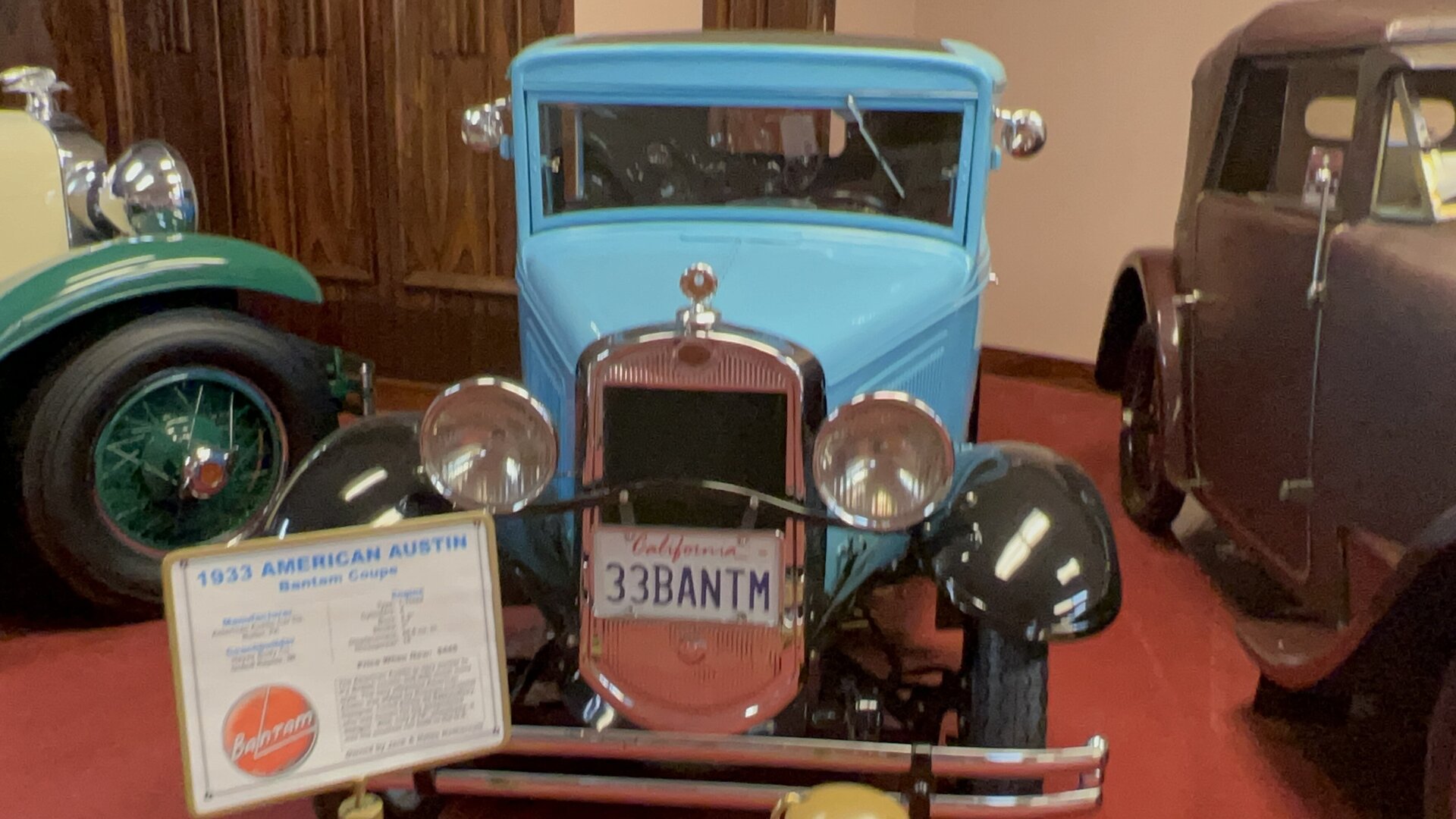
The 1933 American Austin is what happens when you import a car built for the streets of Coventry into a country where the roads were designed for a Model T with a family of six inside. It was a serious little machine, engineered to full-size standards, and it failed commercially in the most American way possible: it was too small for Americans, and its bankruptcy sale funded the invention of the Jeep.
Built in Butler, Pennsylvania, on an English license.
The American Austin Car Company started production in 1930 in a former farm equipment plant in Butler, Pennsylvania, under license from Herbert Austin's Austin Motor Company in England. The car was a slightly restyled Austin Seven: a 747 cc four-cylinder, three-speed non-synchro gearbox, ten feet from bumper to bumper, 1,100 pounds curb weight. It cost $445 in 1930, undercutting a Ford Model A by more than $100.
On paper it was the right car for the Great Depression: cheap to buy, 40 miles to the gallon, and small enough to park anywhere. In practice it was the wrong car for America. Roads outside cities were still unpaved. Distances were long. Families were large. And American buyers who could scrape together $445 wanted to look like they had scraped together more.
8,558 sold, and then the company went bankrupt.
By 1934 American Austin had built 8,558 cars total and was in receivership. Roy Evans, a Georgia car dealer, bought the entire operation for pennies on the dollar and reorganized it as American Bantam in 1936. He restyled the car with help from Alexis de Sakhnoffsky, dropped the price further, and kept production going through the late 1930s at very low volume.
The bankruptcy that built the Jeep.
In July 1940 the US Army published a specification for a quarter-ton four-wheel-drive reconnaissance vehicle. Ford and Willys ignored it. American Bantam, still starving, took the contract seriously. In 49 days their engineer Karl Probst designed the Bantam Reconnaissance Car, which was accepted, then re-tendered, then handed to Willys and Ford under wartime production sharing. The Willys MB Jeep that fought World War II is a direct descendant of the American Bantam design that came from the factory that failed at selling the American Austin.
So the tiny car in this photograph is not a footnote. It is the reason the Jeep exists. It is the reason the postwar SUV category exists. It is the reason four-wheel drive became a civilian option instead of a military one.
Why this matters to Physical AI.
The American Austin failed for the same reason a lot of technically correct products fail: the market it was engineered for was not the market it was sold into. That is a warning I take seriously at Outonomous. Building the platform turning the planet's 1.6 billion existing vehicles into autonomous machines requires respecting what people actually drive, not what we wish they drove. The installed base is the specification. Ignore it and you build a beautifully engineered thing that nobody wants.
"The little Austin was correct. It was small, cheap, efficient, and completely wrong for the country it was sold into. Engineering is only half the answer. The other half is meeting the fleet where it actually is."
Omar Mukhtar, field note
Background reading
For further reading: search the public record for 1933 American Austin, and visit the Nethercutt Collection, where Omar studied and photographed this material first-hand.
Copyright
Photographs © 2026 Outonomous. All rights reserved. Image rights are held by Outonomous and may not be reproduced without written permission.