Entry 053 · Nethercutt Collection · Field study
The evolution of the car headlamp, from an oil lantern in 1885 to a matrix LED in 2026.
Acetylene gas headlamps in 1900. Sealed beam tungsten filaments standardized in 1940. Halogen in 1962. Xenon HID in 1991. LED in 2007. Matrix laser LED today. Each jump changed how far a driver could see, how heavy the car had to be, and how many people survived the night.
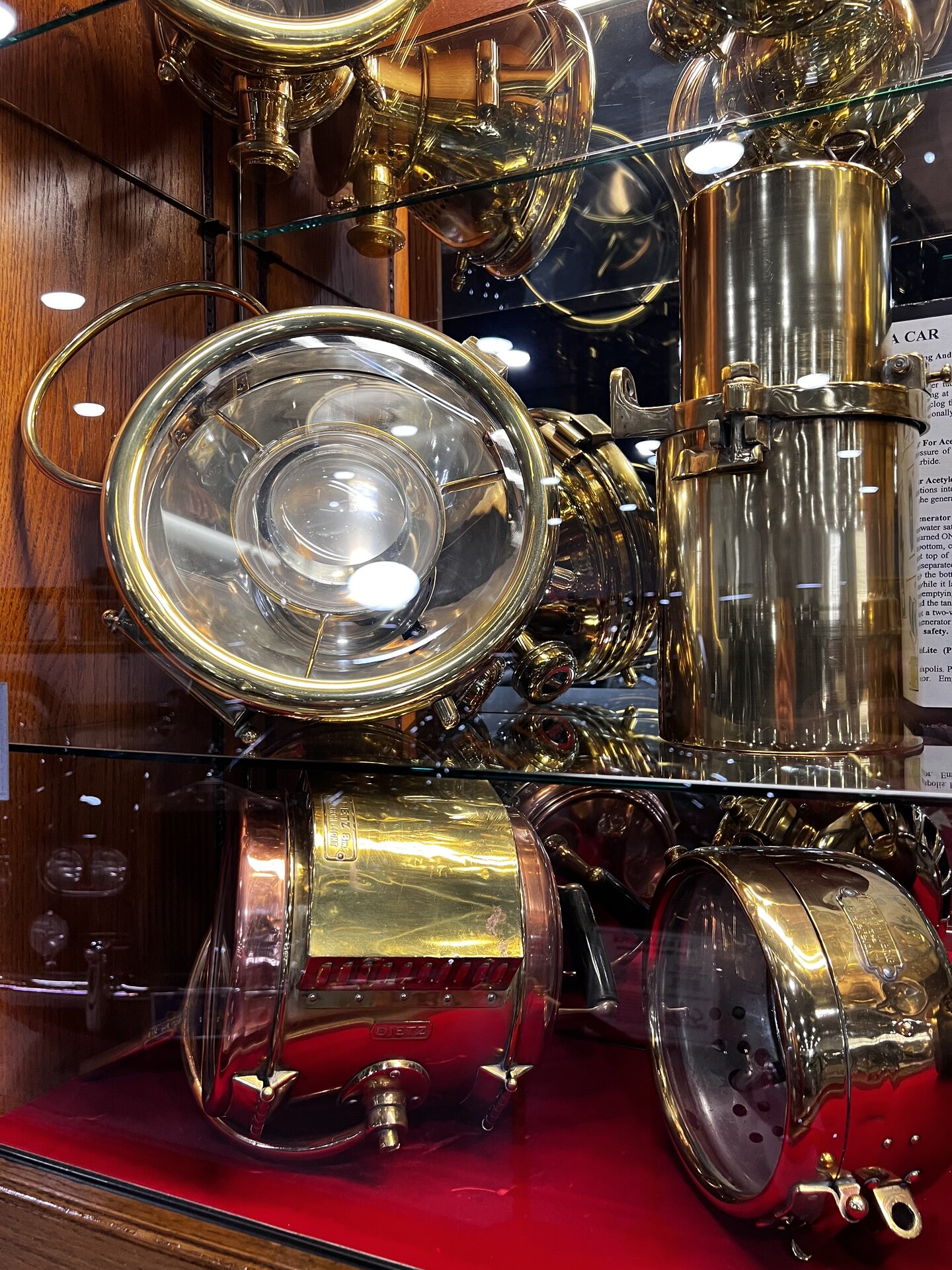
The 141-year evolution of the automobile headlamp is the story of how humans learned to drive at night. Every jump in the technology, from an open flame in a brass housing to a laser diode aimed by a computer, was earned by counting the dead on the road the year before. Better light is not a styling choice. It is a public health intervention.
Oil lanterns and acetylene: 1885 to 1908.
The first automobiles used the same lamps carriages used: an oil-fed wick behind a glass lens, throwing perhaps ten feet of usable light. By 1900 the industry had moved to acetylene: calcium carbide dropped into water inside a canister generated gas that burned bright and white through a burner mounted in a polished brass reflector housing on the front of the car. Prest-O-Lite in Indianapolis, founded in 1904, became a Fortune 100 company selling acetylene tanks to motorists. Beam distance jumped to roughly 100 feet. The driver still had to light the lamps by hand with a match.
Electric filament bulbs: 1908 onward.
Cadillac introduced electric lighting on the 1912 model year using a Delco electrical system, and the industry followed within a decade. Filament bulbs behind a parabolic reflector were dimmer than acetylene at first but had no open flame, no gas canister, no matches. In 1940 the US federal government mandated the sealed beam headlamp: a single glass unit combining bulb, reflector, and lens, standardized at seven inches round. That standard held for 43 years and made replacement a five-minute job in any garage in America.
Halogen, xenon, LED, laser: 1962 to today.
Halogen bulbs in 1962 gave 50 percent more light for the same power. Xenon high-intensity discharge in 1991 tripled beam distance and pushed color temperature toward daylight. LED headlamps arrived on the 2007 Lexus LS 600h and inside ten years took over the industry. Today's matrix LED and laser systems, first shipped on the 2014 Audi A8 and BMW i8, use hundreds of individually addressable diodes steered by camera-based software. The high beam is on all the time and the system carves holes in it around oncoming traffic in real time. The driver never touches the switch.
Why headlamps matter to autonomy.
Half of all US traffic fatalities happen at night despite night driving being only about a quarter of total miles. The headlamp is the perception system for the human driver. As soon as perception moves off the human retina and onto machine sensors, the headlamp itself becomes negotiable: LiDAR, radar, and thermal cameras see through darkness the human eye cannot penetrate. At Outonomous we treat perception as the missing layer on the 1.6 billion vehicles already on the road. The headlamp is the receipt of what the industry already believed: give the driver better perception and the road gets safer. Now the perception layer is compute and sensors, and the target is 100 million lives saved.
"Every headlamp generation was justified by the previous decade's crash statistics. Perception saves lives. That is the whole story of the automobile at night, and it is the whole thesis of Physical AI."
Omar Mukhtar, field note
Background reading
For further reading: search the public record for car headlamp evolution, and visit the Nethercutt Collection, where Omar studied and photographed this material first-hand.
Copyright
Photographs © 2026 Outonomous. All rights reserved. Image rights are held by Outonomous and may not be reproduced without written permission.