Entry 052 · Nethercutt Collection · 1937
The train control room of the 1937 Royal Hudson, and how railroads built the modern world.
The photograph is the cab of the 1937 Canadian Pacific Royal Hudson locomotive. Railroads compressed continents, standardized time zones, opened settler frontiers, moved armies, and today still carry 40 percent of US ton-miles of freight, more than trucks and pipelines combined.
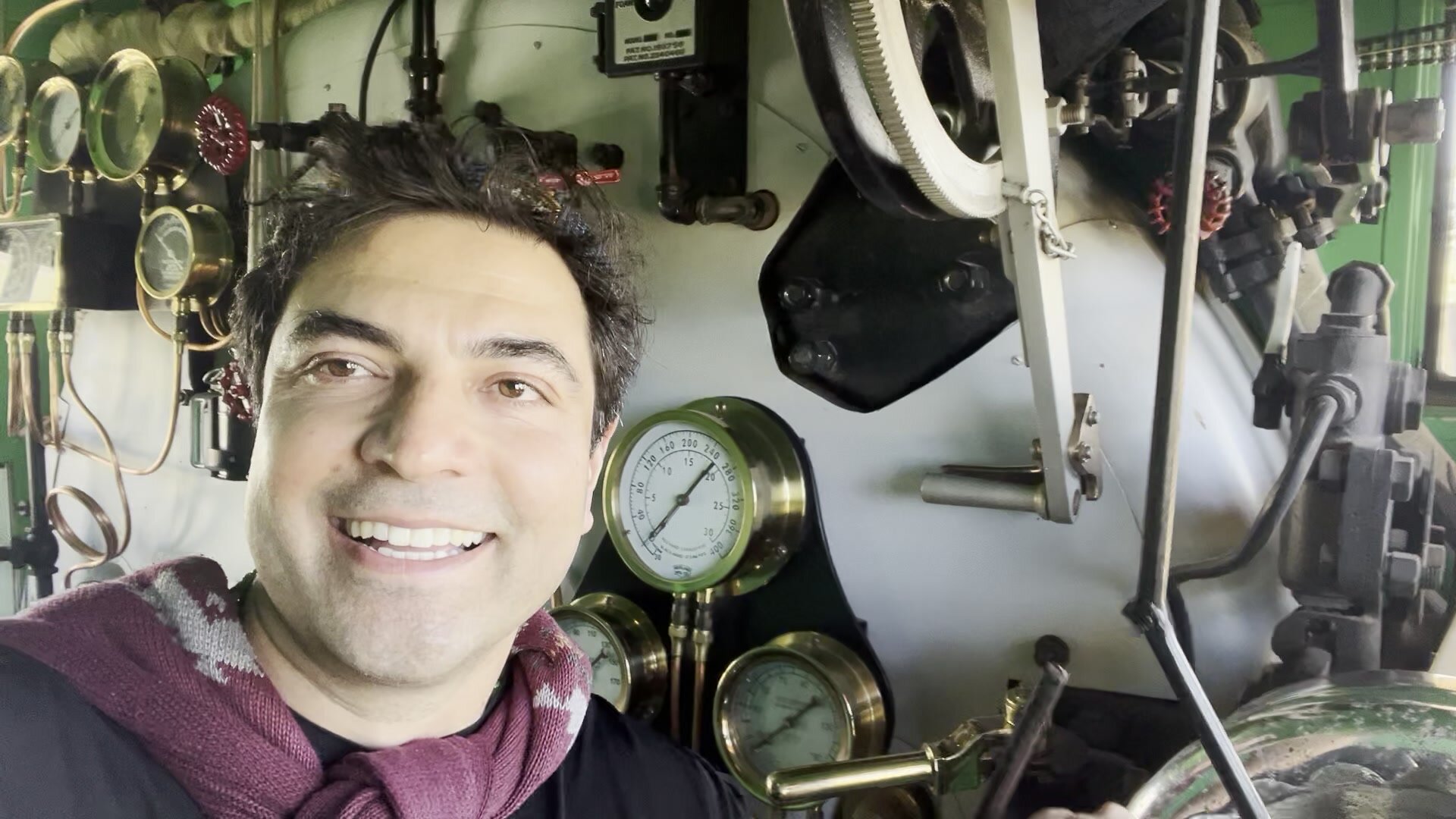
This photograph is the cab of the 1937 Canadian Pacific Royal Hudson 2860, the steam locomotive that carried King George VI across Canada in 1939. Every gauge, every valve, every steel handle in this cab was moved by a two-person crew running a 300,000-pound machine at 90 miles per hour across a continent that only existed as one country because trains had made it one.
The transportation revolution began on rails.
Before the railroad, moving a ton of freight from Boston to St. Louis took six weeks and cost more than the freight was worth. After the railroad it took three days and cost less than a dinner. That is not an improvement. That is a different civilization. Time zones exist because railroads needed them: the four continental US time zones were invented on 18 November 1883 by the railroads, then adopted by the federal government 35 years later. The stock ticker, the telegraph, standard gauge, standardized bolts, standardized couplers, and the entire discipline of industrial engineering came out of the operational problem of making trains not crash into each other.
The Hudson cab is a control room.
Inside the cab of the 2860 the engineer worked the throttle, the reverser, the air brake, and the injector. The fireman shoveled coal, worked the blower, watched the water glass, and read the boiler pressure. There were no computers. There was no cruise control. There was no autopilot. Speed was managed by ear, by feel, and by an obsessive knowledge of every grade and curve on the assigned route. A Hudson could pull an 18-car passenger train up the Selkirk Mountains and hold 65 mph on the flats to Vancouver. In 1939 it hauled the King's train 3,224 miles across Canada without a single mechanical failure, which is how the class earned the name Royal Hudson from the King himself.
Trains still underpin the economy.
The romance of rail is a museum feeling. The economic reality is not. US freight railroads move roughly 40 percent of the country's long-distance freight ton-miles, more than trucks and pipelines combined. A single freight train removes several hundred long-haul trucks from the interstate. In Europe, high-speed passenger rail moves more people between city pairs than airlines. In Japan, the Shinkansen has carried more than ten billion passengers without a single passenger fatality from a derailment or collision since it opened in 1964. Rail is still the most energy-efficient way to move mass on land, by a factor of three to four over trucking.
Why this belongs in the Physical AI archive.
Railroads were the first Physical AI system, in the sense that mattered: they were a distributed control problem larger than any single human could solve, and they were solved by combining hardware, signaling, standardization, and human discipline into one coordinated network. Roads are now the same problem at a much larger scale. There are 290 million cars in the United States, 1.6 billion vehicles worldwide, and no coordinated control layer. That is what Outonomous is building. The rails already showed the payoff: standardize the perception and control layer and mass transportation becomes safe, fast, and cheap. The road just has to catch up.
"The Hudson cab is a working monument to the first Physical AI network humanity ever built. Rails, signals, timetables, and human discipline made the continent one thing. Roads are the next network. That is the work."
Omar Mukhtar, field note
Background reading
For further reading: search the public record for Royal Hudson cab and the railroad transportation revolution, and visit the Nethercutt Collection, where Omar studied and photographed this material first-hand.
Copyright
Photographs © 2026 Outonomous. All rights reserved. Image rights are held by Outonomous and may not be reproduced without written permission.