Entry 050 · Nethercutt Collection · Field study
Rolls-Royce and Henry Royce, the poor overworked engineer who built the best car in the world and then never worked again.
Henry Royce grew up delivering newspapers and telegrams to keep his widowed mother fed. He built Rolls-Royce by working himself into a nervous collapse in 1902 and never returned to a full workday. It is poetic that the most restful car in the world was engineered by a man who did not know what rest was.
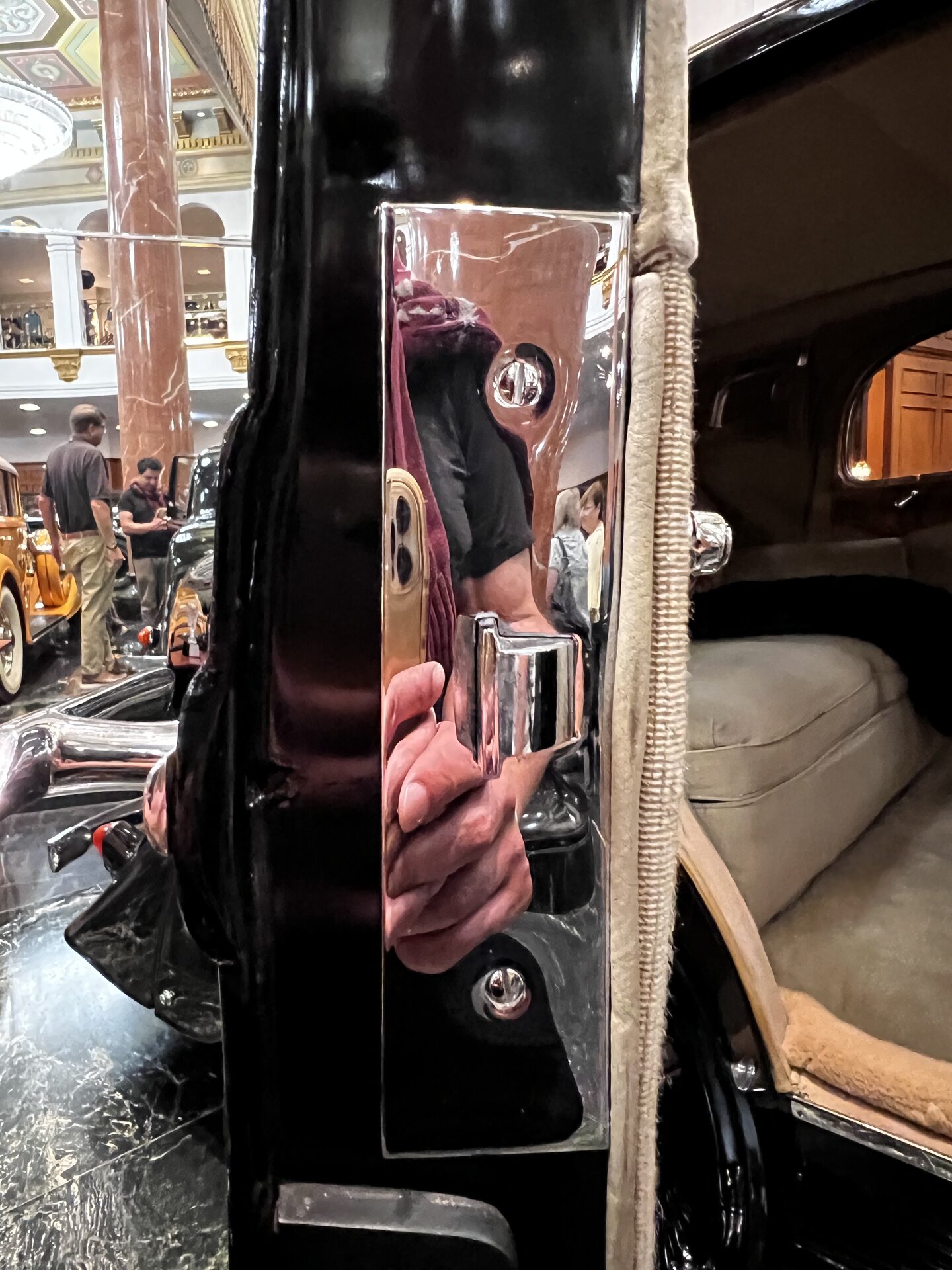
Henry Royce was born in 1863 in a Lincolnshire flour mill that failed. He sold newspapers at nine years old, delivered telegrams at fourteen, apprenticed at the Great Northern Railway workshops until his aunt's money ran out, then walked to Leeds and took a factory job. He was self-taught. He worked eighteen-hour days for the next twenty-five years. In 1902 his body gave out. He never worked a full workday again, and everything that carries his name was built by the company he had already broken himself building.
The poor boy who taught himself electricity.
When his father died Royce was nine. When his aunt's money for schooling ran out he was fifteen, with one year of formal education total. He was the kind of engineer who could not stop reading, could not stop building, could not stop improving. He taught himself electric lighting, dynamo design, and machine tools. In 1884 he started F. H. Royce and Company in Manchester with £70 of savings, building electric cranes and dynamos. The workmanship was so obsessive that Royce dynamos were still running fifty years after installation.
The 1902 collapse.
By 1902 he was 39 years old and had worked continuously for a quarter century, sleeping in the factory, eating at the bench, personally inspecting every product. His nervous system gave out. He was ordered by his doctor into complete rest, and never returned to a normal working life. To distract himself during his convalescence he bought a second-hand Decauville motor car, decided it was badly made, and built three of his own to prove it could be done better. Those three cars, the Royce 10, were the first Rolls-Royces.
The company his broken body built.
Charles Rolls, the aristocrat car dealer from Mayfair, drove one of the Royce 10s in 1904 and immediately signed a deal to sell every car Royce built under the name Rolls-Royce. The 1907 Silver Ghost, engineered by Royce, was proclaimed by The Autocar magazine as "the best car in the world" after a 15,000-mile non-stop trial. Royce himself was by then too fragile to work in the factory. He designed from a drafting table at his home in West Wittering on the Sussex coast, later at Le Canadel in the south of France, sending drawings by courier to Derby. He never returned to Manchester as a full-time engineer. He died in 1933 at 70, still designing, still not resting.
The poetry of it.
The most restful car in the world was designed by a man who did not know what rest was. Rolls-Royce sold silence, isolation, effortless motion, the total absence of mechanical worry. Every one of those qualities was the exact opposite of the life Henry Royce actually lived. Burnout has a cost, and the cost is usually paid in the years you do not get back. Royce paid it, and the car paid the debt forward to every passenger who ever sat in one.
The lesson I take.
I run Outonomous hard. I know what Royce cost himself. The mission of 100 million lives saved is worth the work, but it is not worth the wreck. The best engineers I have known lived long enough to see what they built. Royce almost did not. The interior of a Rolls-Royce is a permanent argument that rest, silence, and calm are engineering deliverables. It is worth remembering the man who built them could not deliver them to himself.
"Henry Royce sold the world silence. He never got to have any himself. That is a warning as much as a legacy."
Omar Mukhtar, field note
Background reading
For further reading: search the public record for Rolls-Royce and Henry Royce, and visit the Nethercutt Collection, where Omar studied and photographed this material first-hand.
Copyright
Photographs © 2026 Outonomous. All rights reserved. Image rights are held by Outonomous and may not be reproduced without written permission.