Entry 049 · Nethercutt Collection · Field study
Rolls-Royce caning and the lost art of ordering a car to your own specification.
Woven cane on a coachbuilt body was standard on pre-war Rolls-Royces. Owners specified everything: wood species, headliner cloth, monograms, drinks cabinets, secret compartments. Today's cars are configurators. What was once a two-year commission is now a checkbox, and the market has forgotten what real personalization felt like.
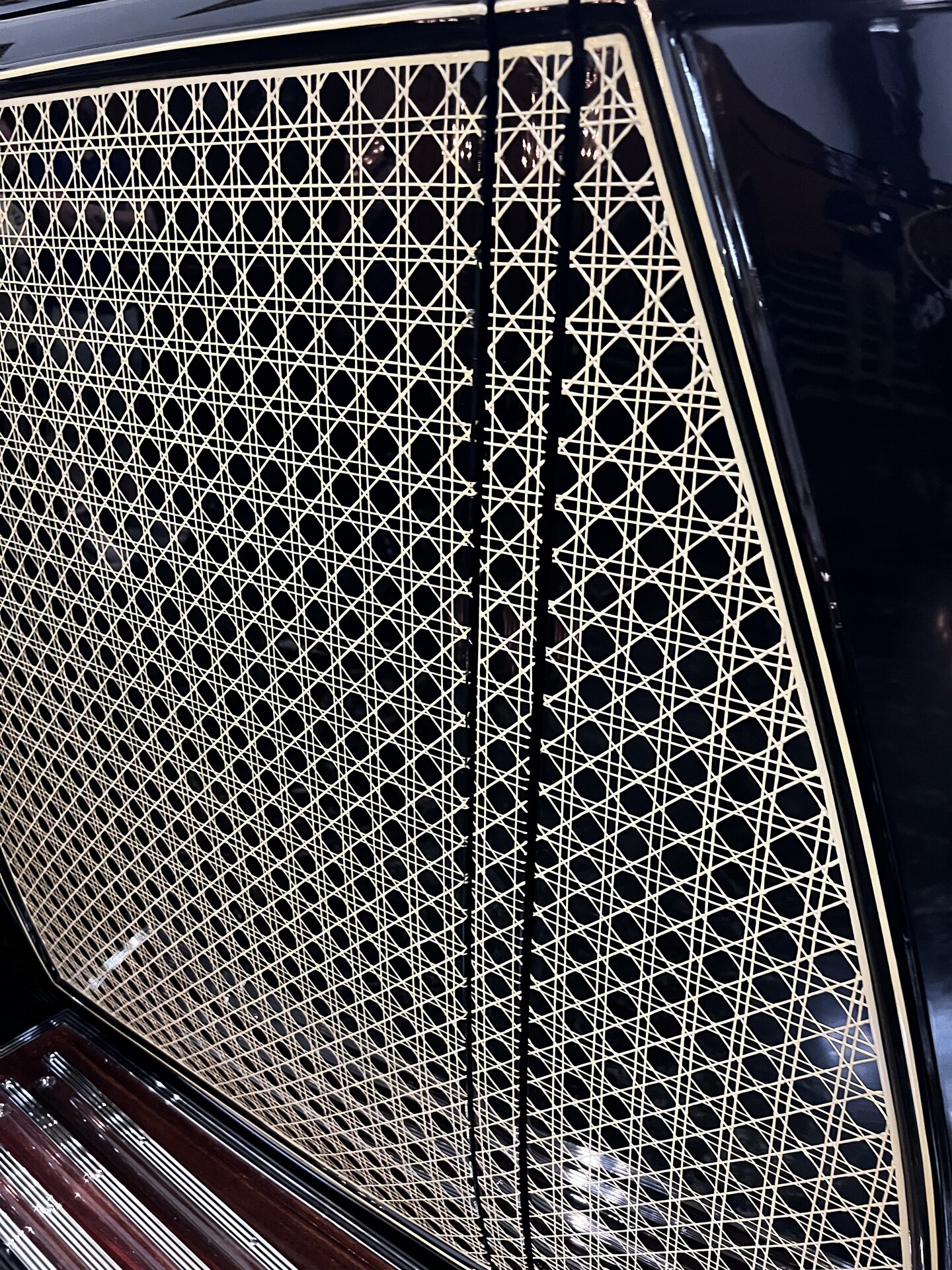
Woven cane on the exterior of a Rolls-Royce is a survival from the carriage era, when a body was ordered like a suit and every square inch was specified by the owner. Between the wars, no two coachbuilt Rolls-Royces were the same car. Today's bespoke programs are configurators with a marketing budget. Personalization at the level Royce customers took for granted is essentially extinct, and the market has forgotten what it felt like.
What Rolls-Royce actually sold before 1965.
A pre-war Rolls-Royce was sold as a rolling chassis: engine, transmission, wheels, dashboard, and a bare frame. The customer then commissioned a coachbuilder such as Hooper, Park Ward, Barker, Mulliner, Thrupp & Maberly, or in the United States Brewster and Willoughby, to build the body on top. The coachbuilder took orders in person. The customer chose the profile, the door count, the roof line, the wood species for the cabin, the leather grade for the seats, the color and pattern for the headliner, the placement of the drinks cabinet, the location of secret compartments for jewelry, and yes, the woven cane on the exterior panels if that was the look they wanted.
The caning itself.
Cane was woven by hand onto lightweight wooden or aluminum panels, then varnished and fitted to the body. It served no mechanical purpose. It was a signal that the car was a landau, a carriage, a country house on wheels rather than a machine. Owners who ordered it did so because their grandfathers' carriages had it. In the 1920s and early 1930s a substantial minority of Rolls-Royce, Daimler, and Hispano-Suiza owners still specified it. By 1935 it was rare. By 1939 it was gone.
Why personalization died.
Three things killed the coachbuilt car. First, monocoque unibody construction from the late 1930s eliminated the separate chassis, so there was nothing to bolt a custom body onto. Second, the Depression and then the war destroyed the customer base that could afford a two-year commission. Third, factory bodies, especially from Pressed Steel in Britain, achieved a standard of finish that the average buyer could no longer distinguish from a hand-built body at a tenth of the cost. By 1965 Rolls-Royce had absorbed its last remaining coachbuilder, Mulliner Park Ward, and every car that left Crewe left with a body designed by the factory.
What is called bespoke today.
Modern Rolls-Royce, Bentley, and every luxury brand that runs a "bespoke" program is really running a highly personalized configurator. The customer can pick a paint from 44,000 options, thread color, veneer, embroidered headrest, monogram, and starlight headliner. The body shell, the chassis, the greenhouse, the door count, the roofline, and the proportions are fixed. That is not bespoke in the pre-war sense. That is customization. The 1929 owner who ordered a Phantom II with woven cane exterior panels, a fold-down writing desk, and a compartment for a shotgun was buying something the modern customer cannot buy at any price.
What this has to do with autonomy.
The coachbuilt era teaches a durable lesson: the platform matters more than the ornament. The best chassis of the era, Rolls-Royce, Duesenberg, Bugatti, Hispano-Suiza, carried a thousand different bodies because the platform underneath was so good. That is the argument for Outonomous. The world already owns 1.6 billion great chassis. The right move is not to build 1.6 billion new ones. It is to install the missing layer, the perception and control layer, and let each vehicle keep its own body, its own owner, its own life. Personalization survives. Only the mechanical intelligence changes.
"The carriage era owner treated the car as an extension of his household. Today's buyer treats it as an extension of his brand. The chassis is still the point. Everyone forgot."
Omar Mukhtar, field note
Background reading
For further reading: search the public record for Rolls-Royce caning and personalization, and visit the Nethercutt Collection, where Omar studied and photographed this material first-hand.
Copyright
Photographs © 2026 Outonomous. All rights reserved. Image rights are held by Outonomous and may not be reproduced without written permission.