Entry 045 · Nethercutt Collection · Field study
The Pierce-Arrow Motor Car Company, the Buffalo firm that put the headlights in the fenders.
Started as a bird cage and refrigerator maker. Built the presidential fleet from Taft to FDR. Pioneered fender-mounted headlamps in 1913, aluminum bodies, hydraulic tappets, and power brakes. Killed by the Depression in 1938, but every American luxury car after copied its detail obsession.
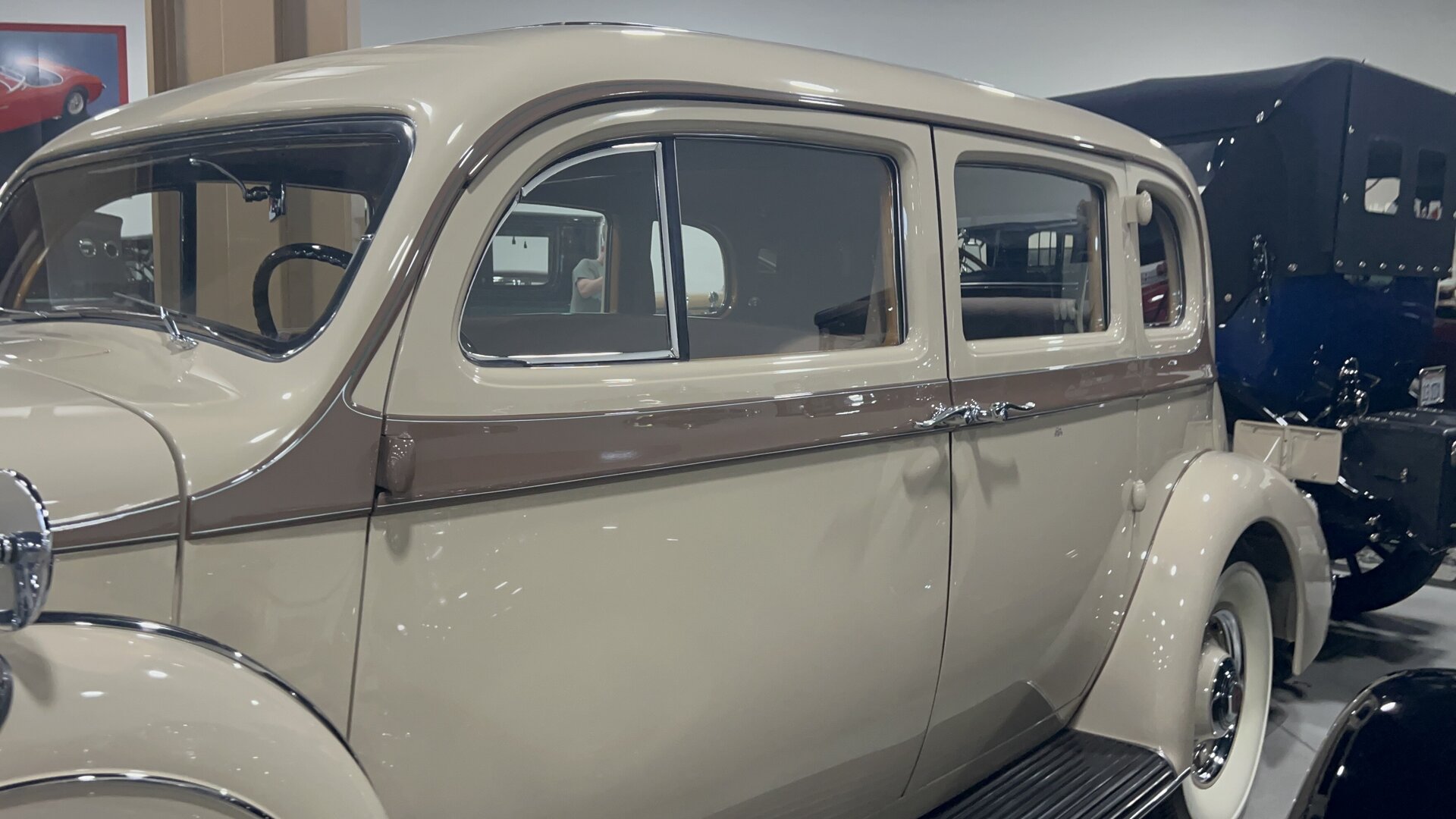
The Pierce-Arrow Motor Car Company of Buffalo, New York, built automobiles from 1901 to 1938. It supplied the presidential fleet from William Howard Taft through Franklin D. Roosevelt. It invented the fender-mounted headlamp. It pioneered aluminum bodies, hydraulic valve lifters, and power brakes. It killed itself trying to survive the Depression, and every American luxury car that came after copied its detail obsession without ever fully replacing what it was.
From bird cages to automobiles.
The company began in 1865 as Heinz, Pierce and Munschauer, a Buffalo maker of household goods: iceboxes, bird cages, bathtubs. George N. Pierce bought his partners out in 1872 and moved into bicycles in the 1890s, which is the standard American path from Victorian metalwork into the automobile. In 1901 Pierce built its first car, a single-cylinder Motorette based on a de Dion-Bouton engine. By 1903 it was building four-cylinder Great Arrows. In 1904 a Great Arrow won the first Glidden Tour, a 1,000-mile reliability run through New York and New England, and won it again in 1905, 1906, 1907, and 1909. That put Pierce-Arrow on the national map.
The Great Arrow becomes the Pierce-Arrow.
In 1908 the company renamed itself the Pierce-Arrow Motor Car Company and moved into a new factory on Elmwood Avenue in Buffalo, designed by the industrial architect Albert Kahn: a modern reinforced-concrete plant that could build a car from raw casting to finished body. Pierce-Arrow was one of the very few American manufacturers that made its own bodies in-house at the highest quality. Between 1909 and 1928 Pierce-Arrow was on the "Three P" short list of American luxury: Packard, Peerless, Pierce-Arrow.
The fender-mounted headlamps.
In 1913 chief engineer Herbert Dawley proposed and patented an integrated headlamp that flowed out of the front fender rather than sitting on posts in front of the radiator. This became the visual signature of the marque. Every Pierce-Arrow from 1913 onward, with rare exceptions for customers who ordered conventional lamps, wore its headlights inside the fender. It made the car instantly recognizable at any distance. It also improved aerodynamics and reduced the parts count. The idea took the rest of the industry another twenty years to adopt.
The presidential contract.
In 1909 the White House ordered two Pierce-Arrow Model 48 tourings for President Taft, the first factory-purchased official presidential automobiles. Pierce-Arrow supplied every presidential car through the Wilson, Harding, Coolidge, Hoover, and Franklin Roosevelt administrations. Franklin Roosevelt drove a hand-controlled Pierce-Arrow at his Hyde Park estate. When Pierce-Arrow finally went bankrupt in 1938, the presidential fleet contract transferred to Cadillac and Lincoln.
The Studebaker merger and the end.
In 1928 Pierce-Arrow merged with Studebaker to gain access to volume manufacturing and dealer networks. The Studebaker connection produced the beautiful 1933 Silver Arrow show car, five of them built for the Chicago World's Fair, streamlined ten years before the industry caught up. But the Depression destroyed the luxury market. Studebaker itself went into receivership in 1933 and spun Pierce-Arrow back out. Pierce-Arrow struggled on independently until 1938, when it was liquidated. The Buffalo factory was sold and eventually demolished. The presidential contract, the fender-mounted lamps, and the detail standard survived as influences on every American luxury car that followed.
The lesson.
Pierce-Arrow shows what happens when a company gets everything right except scale. The engineering was correct. The build quality was extraordinary. The design language was ahead of its time. It was killed by the economic environment, not by the product. That is a durable warning at Outonomous. The mission of 100 million lives saved depends on scale, not just on engineering. Getting the platform right and the business model right are the same problem, not two problems.
"Pierce-Arrow built a better car than most of the companies that outlived it. Excellence is necessary and not sufficient. The scale of the fleet is what saves lives."
Omar Mukhtar, field note
Background reading
For further reading: search the public record for Pierce-Arrow Motor Car Company, and visit the Nethercutt Collection, where Omar studied and photographed this material first-hand.
Copyright
Photographs © 2026 Outonomous. All rights reserved. Image rights are held by Outonomous and may not be reproduced without written permission.