Entry 044 · Nethercutt Collection · Field study
The Packard 4M-2500, the V12 that powered PT boats through World War II.
A 41-liter aluminum-block V12, marinized from Packard's aircraft engine of the same architecture. Three of them per PT boat, 12,500 built for the war effort, and the reason John F. Kennedy's PT-109 could plane at 40 knots into the Solomon Islands.
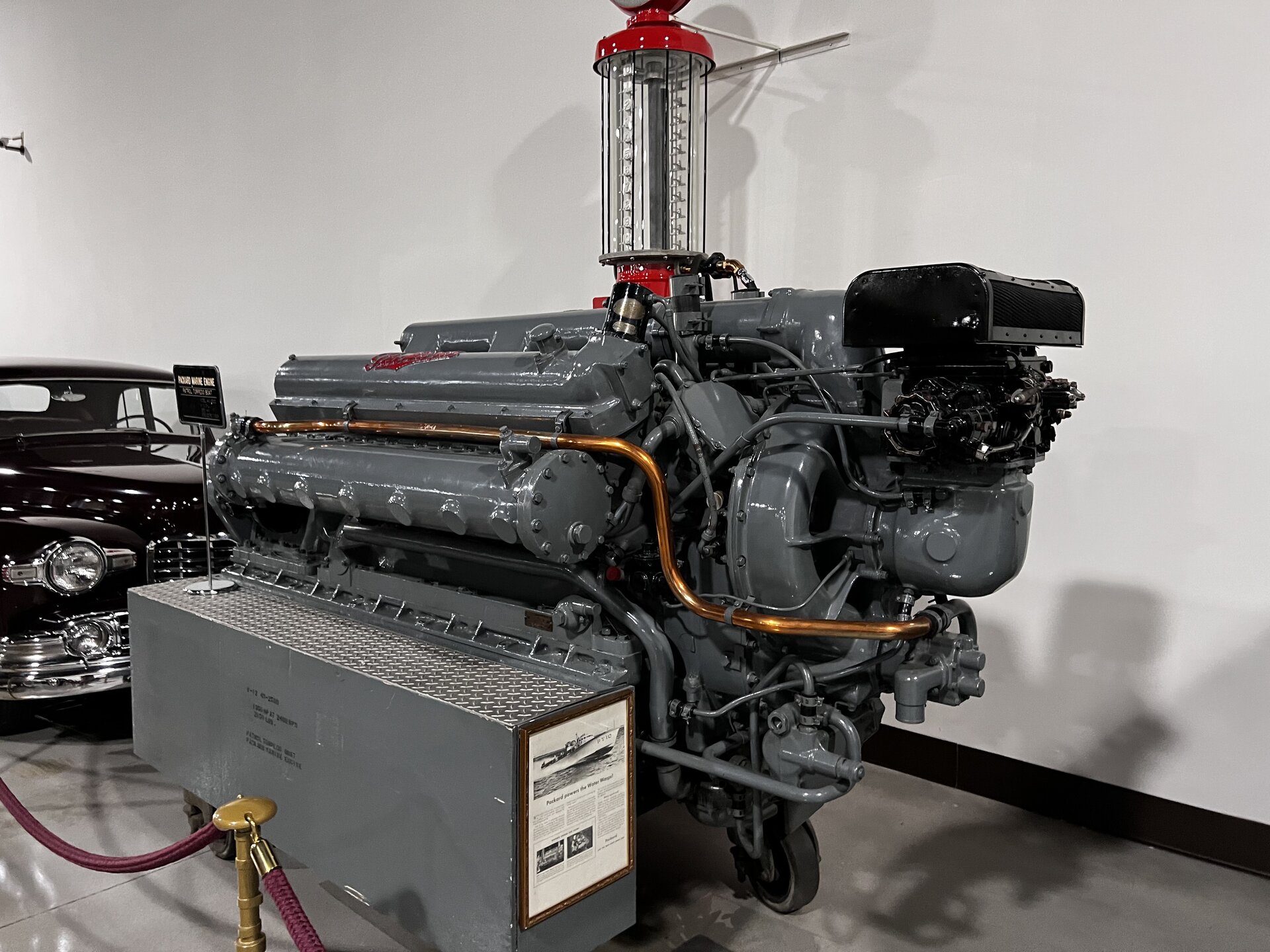
The engine in this photograph is the Packard 4M-2500, a 41-liter aluminum-block supercharged V12 rated at 1,500 horsepower. Three of them per boat powered the US Navy's PT boats through World War II. Twelve thousand five hundred were built. It is the reason John F. Kennedy's PT-109 could plane at 40 knots into the Solomon Islands, and the reason the postwar American V8 could be aluminum-headed and reliable.
The aircraft engine that went to sea.
The 4M-2500 started life as the Packard 1A-2500 aircraft engine of 1927, an aluminum-block 60-degree V12 that Packard designed for the Army Air Corps. When the Navy needed a high-output marine engine for the PT boat program in the late 1930s, Packard reworked the aircraft engine for salt water: cast-iron cylinder liners, marine cooling jackets, dual carburetors, and a two-stage centrifugal supercharger. The final specification: 2,490 cubic inches, four valves per cylinder, dual overhead camshafts per bank, dry weight 2,900 pounds, rated output 1,200 to 1,500 horsepower at 2,500 rpm depending on the version.
Three per boat, 78 feet, 40 knots.
The standard Elco 80-foot and Higgins 78-foot PT boat carried three 4M-2500s, one on each of three shafts. That gave 4,500 horsepower total in a plywood-hulled boat of 55 tons. Fully loaded with torpedoes, machine guns, depth charges, and fuel, a PT could hit 41 knots (47 mph) on plane. In the shallow waters of the Solomon Islands, the Philippines, and the English Channel, that speed was what let 13 men in a wooden boat threaten a Japanese destroyer, a German E-boat, or a supply barge with reasonable odds of survival.
PT-109.
On the night of 1 August 1943 an Elco 80 PT boat numbered PT-109 was struck by the Japanese destroyer Amagiri in Blackett Strait. Its three Packard 4M-2500s were shut down for stealth. The boat was cut in half and the surviving crew of 11 swam three miles to a coral islet. Their skipper was Lieutenant John F. Kennedy, USNR, who received the Navy and Marine Corps Medal for saving his men, and who 17 years later was elected the 35th President of the United States. When President Kennedy visited the Packard plant in Detroit as a candidate he asked to see a 4M-2500 and reportedly touched the block. He had spent nights sleeping next to three of them.
Why the marinized aircraft engine architecture matters.
The 4M-2500 was the largest-volume aluminum-block engine ever produced up to that date. Packard's foundry expertise in casting and machining aluminum at scale is the direct ancestor of every postwar American aluminum V8 head, from the Buick 215 (which became the Rover V8) to the Chevrolet LT and LS families of today. The engineering discipline required to run 1,500 horsepower reliably in a wooden boat in salt water, without catastrophic failure across 12,500 units in production, is not a discipline the peacetime automobile industry had. Packard brought it back to Detroit after the war.
The through-line to Physical AI.
A marine engine is a durability specification with a propeller attached. It has to run at sustained load, manage its own heat, survive vibration and corrosion, and never quit at the wrong moment. Those are the same requirements for the perception and control layer Outonomous installs on the 1.6 billion vehicles already on the road. The autonomy stack that runs at 3 in the morning on a rainy interstate has to be Packard-marine reliable. Anything less and the arithmetic of 100 million lives saved does not close.
"The Packard marine engine had one job: never quit at the wrong moment, in salt water, for 12,500 boats. That is the same specification the perception layer on every vehicle has to meet. There is no lower standard that adds up."
Omar Mukhtar, field note
Background reading
For further reading: search the public record for Packard 4M-2500 marine V12, and visit the Nethercutt Collection, where Omar studied and photographed this material first-hand.
Copyright
Photographs © 2026 Outonomous. All rights reserved. Image rights are held by Outonomous and may not be reproduced without written permission.