Entry 043 · Nethercutt Collection · Field study
Hood ornaments, when a piece of a car was worth stealing off the front of it.
Lalique cast crystal ones. Sculptors like Charles Sykes and Frederick Bazin signed them. They were commissioned, collected, and stolen so often that the entire modern anti-theft industry, from steering locks to immobilizers to GPS trackers, has its roots in what people were willing to do to a car in the parking lot.
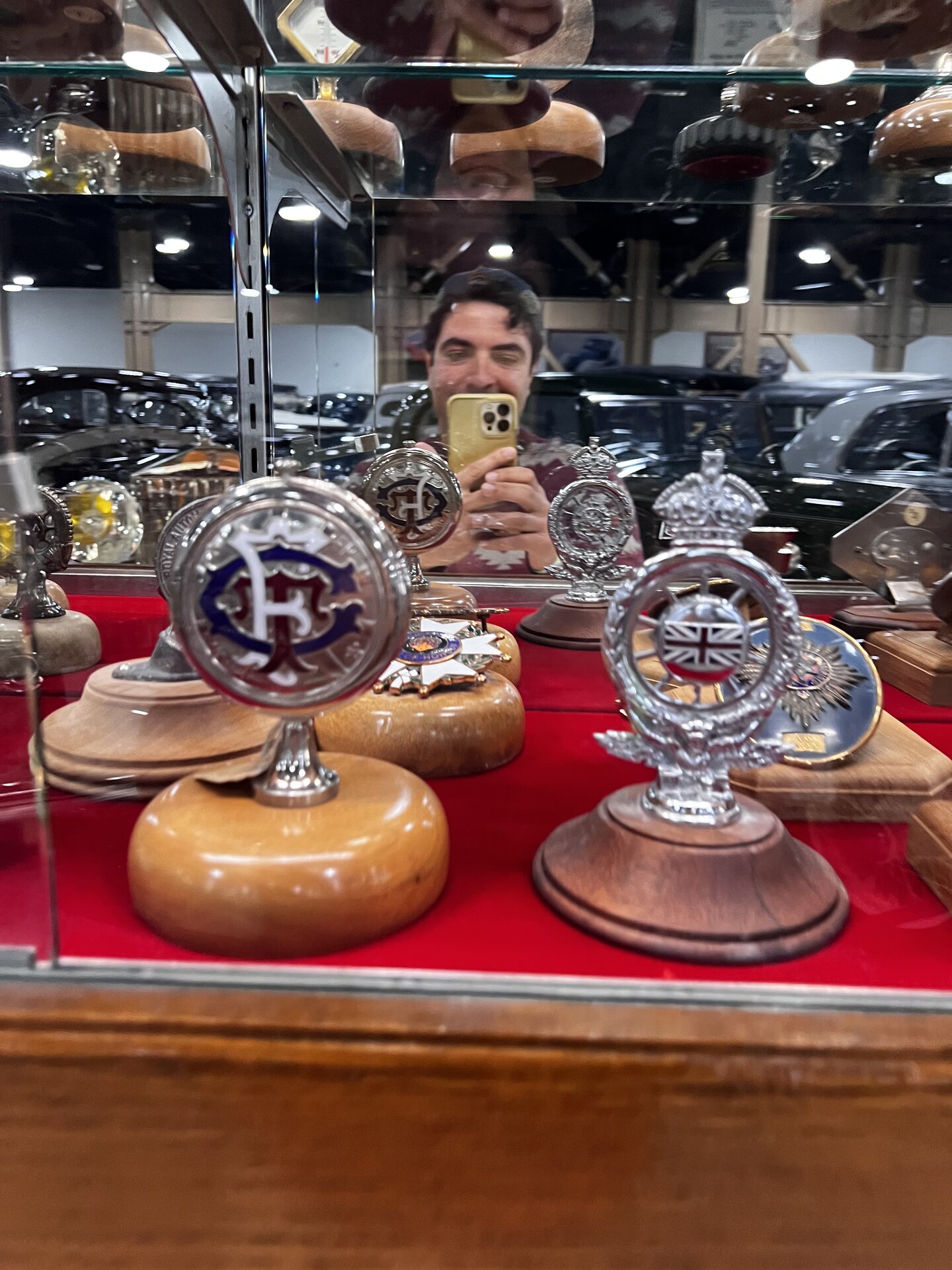
The wall behind me in this photograph is covered in car hood ornaments. Every one of them was a signed art object. Some were designed by René Lalique, cast in crystal, sold at Paris jewelers, and screwed onto the radiators of Bugattis and Voisins by owners who considered a $250 ornament in 1928 a reasonable expense on a $12,000 car. They were commissioned, collected, traded, forged, and stolen. The entire modern automotive anti-theft industry is a story about what people were willing to do to these little sculptures in a parking lot.
The hood ornament as fine art.
Between roughly 1910 and 1935 the radiator cap of a luxury car was treated by owners and manufacturers as a signature space. Charles Sykes did the Spirit of Ecstasy for Rolls-Royce. Frederick Bazin did the Hispano-Suiza stork. Emile Lejeune's foundry in London cast for the Bentley winged B, the Sunbeam, and the Alvis eagle. In Paris, René Lalique produced 29 different designs in press-molded frosted crystal from 1925 to 1935: cockerels, dragonflies, horses' heads, an archer, Victoire (the head of a woman shouting into the wind). Original Lalique mascots today sell at auction for $10,000 to $200,000 depending on the model.
Why they were stolen.
Because a Lalique or a Sykes on the front of a parked car was, in the 1920s, the equivalent of a signed Cartier brooch left on a public bench. Removing one took a screwdriver and 30 seconds. Reselling one required no paperwork. Cities like New York, London, and Paris had established black markets for hood ornaments by the mid-1920s. The theft rate got bad enough that Rolls-Royce, in the 1930s, offered kneeling and lockable variants; that Mercedes-Benz owners kept the three-pointed star locked in a home drawer and only screwed it on for photographs; that some owners in Chicago carried their hood ornaments into restaurants like a hat.
The birth of automotive anti-theft.
Auto theft prevention in general is much older than the LoJack. The first ignition lock on a US car appeared on the 1949 Chrysler. The first factory steering-wheel lock, mandated by US federal law in 1969, was a direct response to the tripling of US auto theft between 1960 and 1969. The kill-switch industry, the LoJack radio tracker (1986), the OBD-II anti-immobilizer chip (1997), the factory GPS trackers of the 2010s, and today's connected-car geofencing all descend from the same instinct that made owners in 1928 pocket the Spirit of Ecstasy before walking into the opera. A car that can be moved by anyone is not a car. It is inventory.
Where anti-theft is going.
Modern high-end vehicles now come with biometric driver authentication, encrypted CAN bus signing, remote immobilization, and geofenced power limits. Insurance fraud, catalytic converter theft, and organized transport of stolen cars to overseas shipping containers is now a multi-billion dollar international problem. The technical answer keeps escalating: the industry is heading toward fully attested drivetrain software, where the car itself refuses to run for any operator that is not cryptographically signed as its owner.
The through-line.
The hood ornaments on the wall behind me are the receipts of a very old lesson: valuable things attract theft, and every layer of value on a vehicle drives a matching layer of security. At Outonomous we are installing a perception and control layer on the world's existing fleet. That layer is itself extremely valuable, and its integrity has to be defended with the same rigor as the drivetrain, the identity, and the compute. The autonomy of a vehicle is worth more than any Lalique mascot. It has to be protected accordingly.
"Every layer of value the industry ever added to a car eventually required its own security layer. The autonomy stack is no exception. If it is worth having, it is worth stealing. Design accordingly."
Omar Mukhtar, field note
Background reading
For further reading: search the public record for hood ornaments and car theft prevention, and visit the Nethercutt Collection, where Omar studied and photographed this material first-hand.
Copyright
Photographs © 2026 Outonomous. All rights reserved. Image rights are held by Outonomous and may not be reproduced without written permission.