Entry 042 · Nethercutt Collection · Field study
A gift from Sabine at the Nethercutt, and why toy cars are the entry drug of the entire car world.
Sabine at the Nethercutt Collection handed me a single die-cast car. Toy cars are how the automobile enters a child's imagination, and they are still traded, collected, and gifted between adults who never grew out of it. Hot Wheels alone has sold more than six billion cars since 1968.
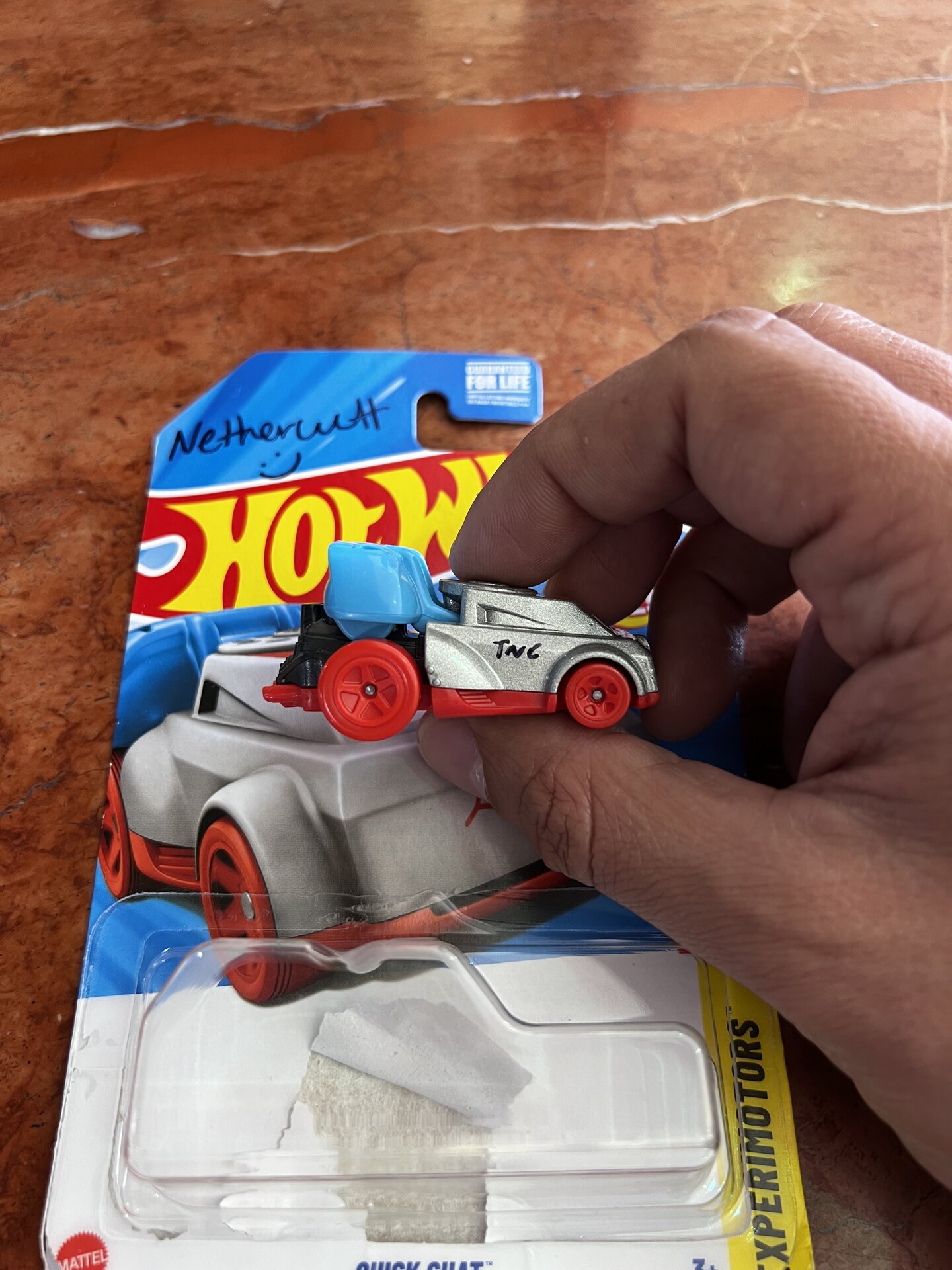
Sabine at the Nethercutt Collection handed me this gift: a single die-cast car. Toy cars are the entry drug of the entire car world. Hot Wheels alone has sold more than six billion of them since 1968. That is more cars than any actual manufacturer in the history of the industry, by a factor of about six.
Muhammad, Sabine, and the docents.
Before the gift there was the tour. Muhammad, Sabine, and the volunteer docents who run the Nethercutt Collection do the invisible work that turns a warehouse of extraordinary machines into a museum where the machines can actually be understood. They know the cars personally. They know which chassis raced at Pebble Beach in what year, which coachbuilder made which body, which owner special-ordered which fitting. They walk visitors through it patiently, in every language they speak between them, without ever making a first-time visitor feel out of place. The Nethercutt is one of the great private museums of the automobile on Earth, and the docents are the reason a walk-in visitor from outside the hobby comes out with the same appreciation as a hundred-year Pebble Beach judge.
Toy cars as first contact.
The first exposure most people ever have to the automobile is a die-cast toy. Dinky Toys started in Liverpool in 1934, Corgi in 1956, Matchbox in 1953, Tomica in Japan in 1970, and Hot Wheels in Southern California in 1968. Hot Wheels alone sells more than 500 million cars per year today. Total production since 1968 exceeds six billion cars. That is more than the total number of automobiles ever manufactured by every real automaker in history combined. The die-cast miniature is not a fringe activity of the car world. It is the front door.
Why Hot Wheels is amazing.
Elliot Handler, co-founder of Mattel, launched Hot Wheels in 1968 with 16 castings designed by an ex-General Motors designer named Harry Bradley. The core innovation was low-friction styrene wheels on thin steel torsion-bar axles: a Hot Wheels car rolled about ten times faster than a Matchbox on the same track. That single mechanical detail turned die-cast cars from static miniatures into a racing toy. The orange plastic track, the loop-the-loop, and the launcher followed within a year. Fifty-eight years later Hot Wheels still ships at scale, still innovates the packaging and the tracks, and still runs an adult collector market where a Redline-era Custom Camaro can sell for $3,500 and a 1969 pink Volkswagen Beach Bomb prototype has been valued at over $150,000.
Gift culture in the car world.
The car world runs on gifts. Docents give visitors booklets. Collectors gift each other rare die-casts, factory sales brochures, period photographs, and small workshop tools. Museums maintain gift shops not for revenue but as an emotional off-ramp: the visitor walks out carrying a physical piece of what they just saw. The Nethercutt does this beautifully. The gift Sabine handed me is not a souvenir in the airport sense. It is an object that keeps the museum's engineering thesis in circulation after the visit ends, the same way a Hot Wheels car keeps a child's first curiosity in circulation until they are old enough to open a hood themselves.
Thank you.
To Muhammad, Sabine, and the entire docent team at the Nethercutt: thank you. What you do is the reason the collection is a living thing and not just a warehouse. Every serious car person I know has a story about a docent who spent an extra 20 minutes with them. That labor of love is why the archive continues to teach.
"Six billion Hot Wheels have been sold since 1968. That is not a toy market. That is how humanity onboards new drivers, one plastic loop at a time."
Omar Mukhtar, field note
Background reading
For further reading: search the public record for Nethercutt gift from Sabine, and visit the Nethercutt Collection, where Omar studied and photographed this material first-hand.
Copyright
Photographs © 2026 Outonomous. All rights reserved. Image rights are held by Outonomous and may not be reproduced without written permission.