Entry 041 · Nethercutt Collection · Field study
The mechanical music instruments of the Nethercutt Collection, when machines were the concert hall.
Cylinder music boxes, orchestrions, reproducing pianos, band organs, and a Mighty Wurlitzer theatre organ. Before recorded sound, this hardware was how a household, a restaurant, or a movie palace produced music. The Nethercutt holds one of the greatest collections on Earth.
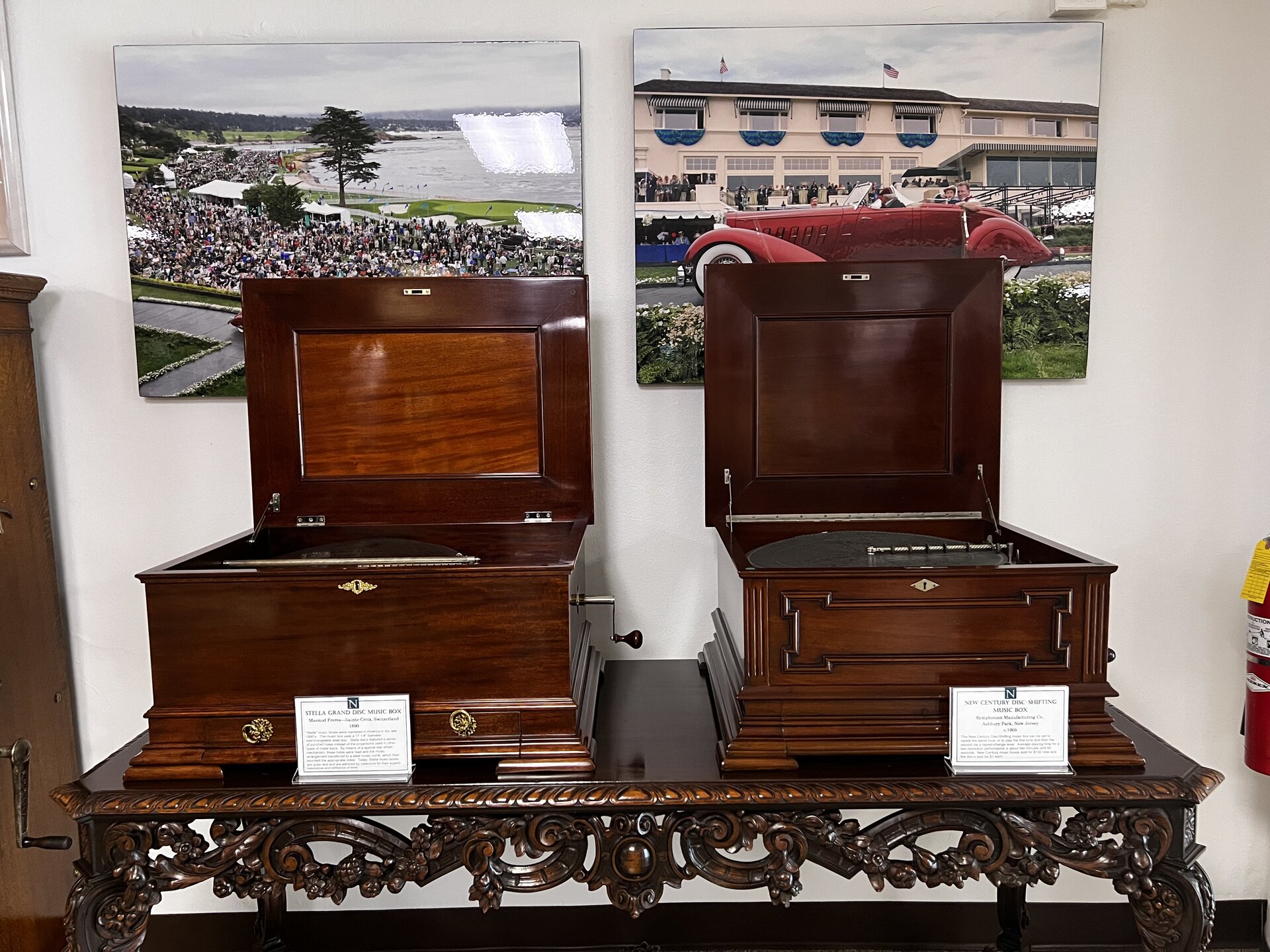
Before Thomas Edison recorded sound in 1877, music in a private home came from a piano someone had to play or from a mechanical instrument that played itself. The Nethercutt Collection holds one of the greatest collections of these self-playing instruments on Earth: Swiss cylinder music boxes, French orchestrions, American reproducing pianos, German band organs, and a Mighty Wurlitzer theatre organ. Together they document how the world got music before the microphone existed.
The cylinder music box, 1796 onward.
Antoine Favre-Salomon, a Geneva watchmaker, invented the cylinder music box in 1796. A rotating brass cylinder studded with pins plucked the teeth of a steel comb; each tooth was tuned to a specific note. By the mid-1800s Swiss towns like Sainte-Croix and Geneva were exporting cylinder music boxes worldwide, some with interchangeable cylinders playing 6, 8, or 12 different tunes. The Nethercutt holds cylinder boxes with drums, bells, and multi-comb harmonizations, mechanical marvels that took a skilled craftsman a full year to complete.
The orchestrion, 1850s to 1920s.
An orchestrion is a self-playing mechanical orchestra: a piano, plus violin pipes, flute pipes, drums, cymbals, and a xylophone, all driven by a paper roll or pinned barrel and powered by an electric motor and a bellows. The great German makers, Welte, Hupfeld, Popper, and Weber, built orchestrions the size of a Victorian sideboard for hotel lobbies, restaurants, brothels, and the drawing rooms of the very rich. The Nethercutt's Salon Music Room contains several of the largest and most complete orchestrions in the world, still working, still playing paper rolls cut a century ago.
The reproducing piano, 1904 onward.
The player piano of the 1890s could play a tune. The reproducing piano of the 1900s could reproduce a specific pianist's performance, including touch, dynamics, and pedaling. Aeolian's Duo-Art system in the United States and Welte-Mignon in Germany recorded live performances by Rachmaninoff, Debussy, Gershwin, Mahler, and Grieg onto master rolls, which were then duplicated and played back on Steinway and Aeolian grand pianos in living rooms worldwide. The Nethercutt owns hundreds of these rolls and the pianos that read them. It is the closest thing that exists to a time machine for the sound of early 20th-century concert piano.
The Mighty Wurlitzer.
The theatre pipe organ was invented to accompany silent films. A Wurlitzer Style 285 or a Kimball can imitate an orchestra: strings, brass, woodwinds, percussion, sound effects, and everything in between, played by one organist from a horseshoe console with three to five keyboards and hundreds of stops. When the talkies arrived in 1927 the theatre organ business collapsed inside three years. The Nethercutt installed one of the great Mighty Wurlitzers, originally from the San Francisco Fox Theatre, in its Cloud 99 room. It is still played publicly.
Music before software.
A pinned cylinder is a stored program. A paper roll is a stored program with dynamics. An orchestrion is a stored program driving a distributed set of actuators. These are the direct mechanical ancestors of every digital instrument alive today. They also ran themselves for decades on nothing more than an electric motor and a bellows, without a single line of code, without a network connection, without the possibility of a software patch. The engineering discipline required to make a machine play music reliably for a century is the same discipline required to make a machine drive a car reliably for a decade. That is why Outonomous takes them seriously. The old machines still work. That is the specification.
"The world had automated symphonies a hundred years before it had automated cars. The mechanism was different. The problem was the same: run reliably, at scale, without a human in the loop."
Omar Mukhtar, field note
Background reading
For further reading: search the public record for mechanical musical instruments, and visit the Nethercutt Collection, where Omar studied and photographed this material first-hand.
Copyright
Photographs © 2026 Outonomous. All rights reserved. Image rights are held by Outonomous and may not be reproduced without written permission.