Entry 040 · Nethercutt Collection · 1930
The Maybach Zeppelin, the pre-war V12 named after the airship its engine flew in.
Wilhelm Maybach was the engineer behind the first Mercedes. His son Karl built a V12 for the Graf Zeppelin airship, then dropped it into a road car and called it the Zeppelin. In 1930 it was the finest German car in production, driven by industrialists, kings, and no one else.
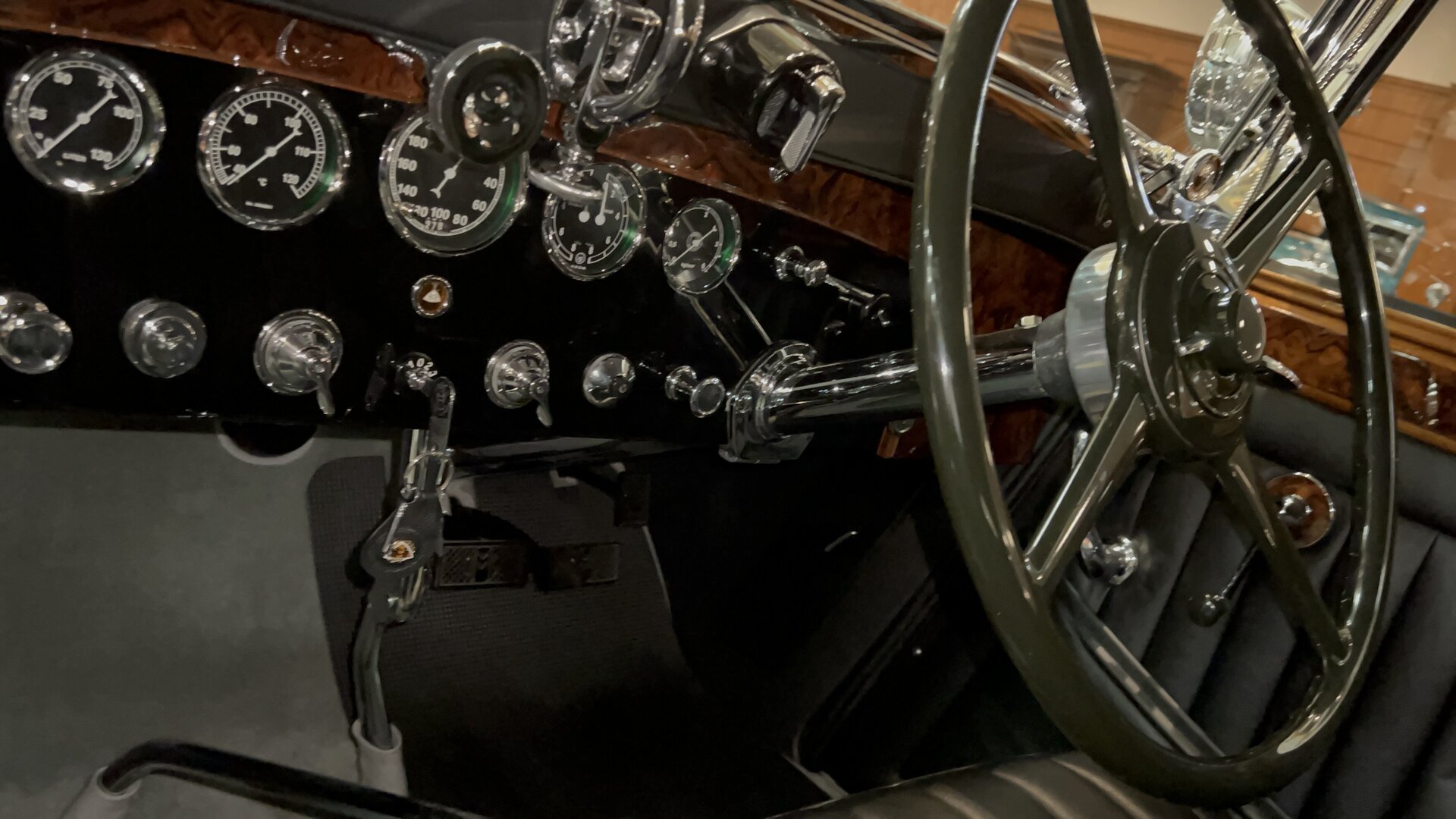
The Maybach Zeppelin was the flagship of Maybach Motorenbau, the German engine and car maker founded by Wilhelm Maybach, the engineer who designed the first Mercedes for Daimler. His son Karl built a 150-horsepower V12 for the Graf Zeppelin airship in 1928, then dropped the same engine into a chassis and put it on the road. In 1930 it was the finest German automobile in production. Nothing else was close.
Wilhelm Maybach, the engineer behind the first Mercedes.
Wilhelm Maybach (1846 to 1929) was Gottlieb Daimler's chief engineer at Daimler-Motoren-Gesellschaft from the very beginning. He designed the world's first four-cylinder passenger car engine in 1898, and in 1901 he designed the 35 hp Mercedes for Emil Jellinek, the car that named the entire Mercedes marque and set the template for the modern automobile: front engine, honeycomb radiator, pressed-steel chassis, low center of gravity, gate-change gearbox. Every car built since is descended from what Wilhelm Maybach drew in Cannstatt in 1900.
Airships, then cars.
After leaving Daimler in 1907 Wilhelm and his son Karl Maybach founded Luftfahrzeug-Motorenbau in Bissingen in 1909, initially to build engines for Count von Zeppelin's rigid airships. The name changed to Maybach-Motorenbau in 1912. Through the First World War Maybach engines powered Zeppelin airships including the Zeppelin bombers over England. After the war, forbidden by the Treaty of Versailles to build aero engines, Maybach pivoted to luxury automobiles. The Type W3 arrived in 1921, the Type 12 in 1929, and the Zeppelin DS 7 and DS 8 in 1930.
The engine.
The Zeppelin's engine was a 60-degree V12 of 7,977 cc (DS 7) or 7,922 cc (DS 8), rated at 150 to 200 horsepower. Aluminum block, dual carburetors, dual ignition (two spark plugs per cylinder, driven by two independent magnetos), and either a five-speed pre-selector transmission (DS 7) or an eight-speed Doppelschnellgang-Getriebe (double overdrive) on the DS 8. The eight-speed transmission was the most complex gearbox in a road car in 1930. It gave the driver essentially any ratio required for a two-and-a-half ton car with a top speed of 105 mph.
How many were built.
Between 1930 and 1940 Maybach built roughly 300 Zeppelins, DS 7 and DS 8 combined. That is a very small number. Each car was coachbuilt by Spohn, Erdmann & Rossi, or the in-house Maybach body shop in Friedrichshafen. Customers were German industrialists, European royalty, and a handful of American collectors who could import a car at what was, in 1930, roughly the price of a small mansion in Berlin.
Why the Zeppelin was different.
Mercedes-Benz built the 500K and 540K. Horch built its 853. Bugatti built the Royale. Each was extraordinary. The Maybach Zeppelin was mechanically the most complex, the most silent, and the most technically ambitious of them. The engine was quieter than a Rolls-Royce Phantom II at speed. The transmission gave the driver more usable ratios than any competitor. The car did not attempt to be beautiful in the Mercedes sense. It attempted to be correct in the airship sense. Every subsystem was engineered to a standard that assumed the customer knew engineering and would not tolerate compromise.
What Maybach became.
Karl Maybach was captured by the French in 1945 and forced to work in France until 1952. The company survived after the war building marine diesels and tank engines. Daimler-Benz acquired it in 1960 as MTU Friedrichshafen. In 2002 Mercedes-Benz revived the Maybach name as a super-luxury brand, discontinued the standalone brand in 2013, and now uses the Maybach name as a top trim level on the S-Class and GLS. The original Maybach, the pre-war one built by Wilhelm and Karl in Friedrichshafen with a Zeppelin engine bolted to a hand-built chassis, is what everything after has tried to reach back to and never quite touched.
"The Maybach Zeppelin was built by engineers who had already put their engine in an airship. That is a different starting point than any competitor had. Everything about the car reads that way."
Omar Mukhtar, field note
Background reading
For further reading: search the public record for Maybach Zeppelin, and visit the Nethercutt Collection, where Omar studied and photographed this material first-hand.
Copyright
Photographs © 2026 Outonomous. All rights reserved. Image rights are held by Outonomous and may not be reproduced without written permission.