Entry 033 · Nethercutt Collection · Field study
The Ford Model A, mass mobility after the Model T changed the world.
The Model A had to do something harder than invent mass motoring. It had to modernize it without losing affordability, serviceability, and the trust Ford had already installed into the public mind.
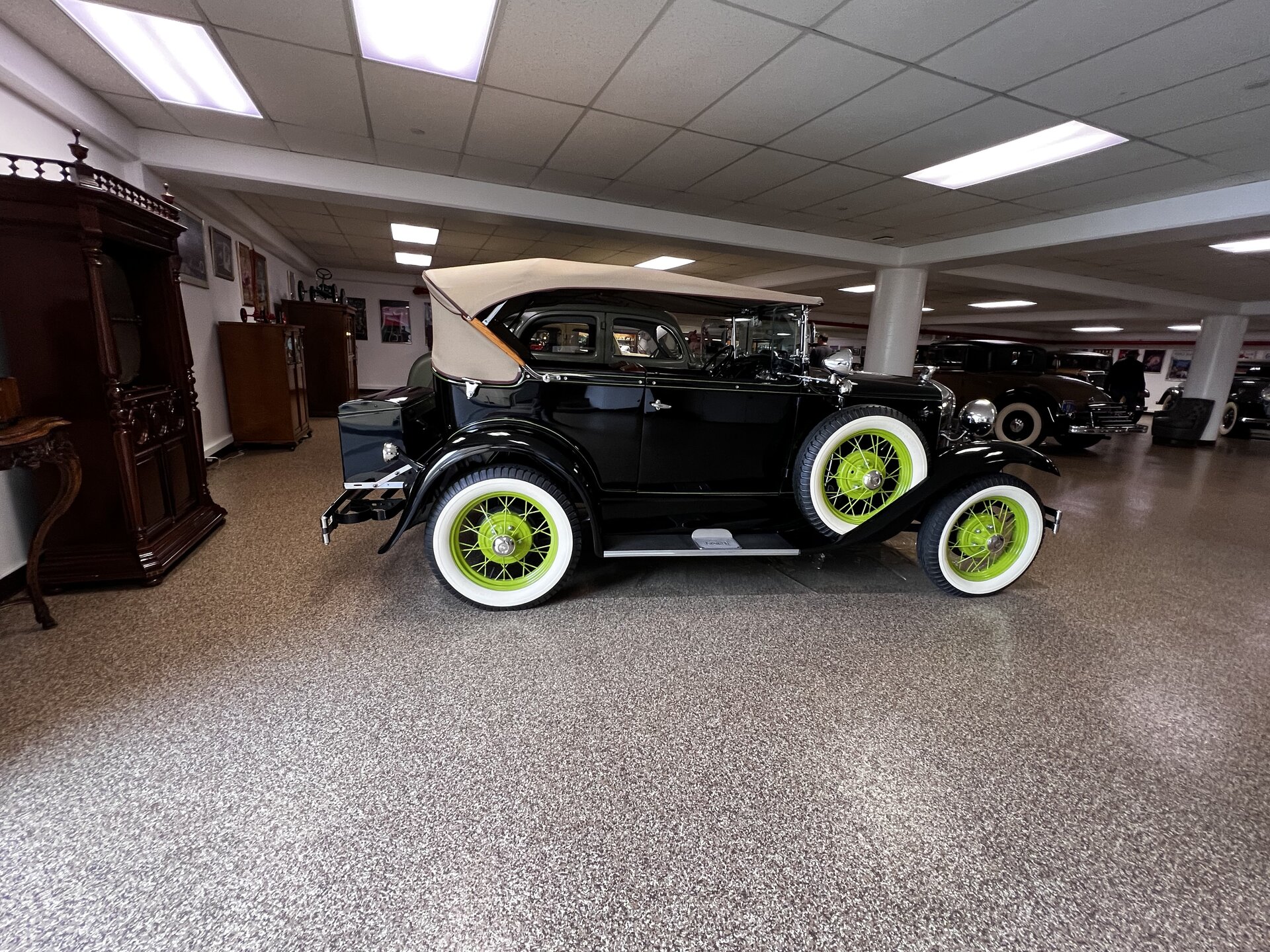
The Model A is the car Ford built when the Model T stopped being enough. After nineteen years and roughly fifteen million Model Ts, Henry Ford shut the River Rouge line down in May 1927 and did not sell a new Ford for almost six months. The Model A was the answer: sliding-gear three-speed, four-wheel mechanical brakes, safety glass windshield, 40 horsepower, and a price that still started at $385. It was the second act of mass motoring, and it decided whether Ford would stay the default car of the world or hand that job to Chevrolet.
Why the Model T had to end.
The Model T was the first car built for the entire installed base of American drivers. It sold at prices that fell from $850 in 1908 to $260 in 1925. It put half the world's cars on the road. But by 1926 it was losing to Chevrolet in the showroom for a reason that had nothing to do with price. The controls were archaic — planetary transmission with foot pedals instead of a gearshift, hand throttle, no fuel gauge, mechanical brakes on the rear wheels only. A generation of new drivers had never learned to drive a T and did not want to. The car that had taught America to drive was now the car that felt hardest to drive.
Henry Ford resisted for years. Edsel Ford, running the company on paper, pushed for a replacement. The decision came in May 1927. Ford closed the Highland Park and River Rouge plants, laid off 60,000 workers, and spent the summer retooling. The new car was designed in months, largely by Edsel for the body and Henry for the mechanicals, and revealed on December 2, 1927. Ten million Americans visited a Ford showroom in the first week to see it. That is not a metaphor. That is the recorded attendance.
What Ford actually changed under the skin.
The Model A was mechanically conventional on purpose. Sliding-gear three-speed manual with a clutch, exactly like every other American car. Four-wheel mechanical brakes, not just rears. A 200.5-cubic-inch L-head four producing 40 horsepower, twice the T's output, running on a 103.5-inch wheelbase. Safety glass windshield as standard — the first car in the world to fit it that way, adopted after Edsel saw the injury data. Electric starter, three-speed with H-pattern shift, standard fuel gauge on the dash. Every one of those was a T driver's complaint answered.
Body engineering is the other half of the story. The Model A was offered in seventeen body styles at launch: Tudor and Fordor sedans, coupe, sport coupe, business coupe, phaeton, roadster, station wagon, taxicab, pickup, panel delivery, and more. Colors returned — Niagara Blue, Arabian Sand, Dawn Grey, Gun Metal Blue — after fifteen years of "any color so long as it is black." The car was not exotic. It was legibly modern, and it was cheap. A roadster started at $385. A Tudor sedan was $500. A Fordor Deluxe was $570. That was the entire pricing argument.
The second act of scale.
Between December 1927 and March 1932, Ford built roughly 4.8 million Model As across four calendar years of production. It reached the millionth car in fourteen months. It sold in Canada, Argentina, Germany, England, Japan, and the Soviet Union — the GAZ-A built at Nizhny Novgorod was a licensed Model A, and it became the base platform for Soviet military and civilian production for years afterward. The Model A did not just replace the T domestically. It exported the American mass-market car to the rest of the world for the second time.
It also lost. Chevrolet's overhead-valve six, introduced in 1929, was smoother and eventually faster to the market than Ford's flathead four. By 1931 Chevrolet was outselling Ford again, and Ford answered in 1932 with the flathead V8. The Model A's production life was less than five years. That short window is the whole point. The car existed to bridge the T era and the V8 era without losing the customer. It did that, and then it was replaced. Platforms are not supposed to be permanent. They are supposed to keep the installed base moving to the next one.
What the Model A proves that still matters.
The Model A is not the car that invented mass mobility. The T did that. The Model A is the car that proved a company operating at planetary scale could shut its own line down, retool, and re-enter the market with a fundamentally different product without losing its customers. That is a harder problem than the first one. Any new entrant can invent a category. Very few incumbents can replace their own defining product on their own timeline. Ford did it once, in 1927, under pressure from Chevrolet, and it worked well enough to buy the company another decade at the top.
It also proves something about how upgrades reach a fleet. Ford did not ask fifteen million Model T owners to buy a Model A on day one. The T stayed on the road for decades — parts, service, and aftermarket support kept it running into the 1950s and beyond. The Model A entered above it, at roughly the same price, and let owners upgrade when their T finally died. The installed base was respected. The upgrade was optional. The new platform still won, because it was better and because Ford kept the price honest.
The line to Outonomous.
Outonomous is building for the same shape of problem. There are 1.6 billion vehicles on the road today. They are not going away, and no fleet of new autonomous vehicles is going to be manufactured fast enough to replace them at planetary scale in any reasonable window. The way autonomy reaches the installed base is the way the Model A reached the Model T fleet: an upgrade path that respects the vehicles already on the road, delivered at a price the ordinary owner can accept, mechanically conventional enough to be serviced anywhere, and legibly better than what came before on the axes that matter — in our case, safety, attention, and the ability to catch a two-second lapse before it becomes a consequence.
Every one of the Model A's design decisions is an autonomy lesson in disguise. Four-wheel brakes instead of rear-only: coverage matters more than peak capability. Safety glass as standard: the safety feature has to be on every car, not just the flagship. Seventeen body styles at launch: the same underlying platform has to fit passenger, commercial, and utility use. Prices held at Model T levels: an upgrade that only reaches the top of the market does not move the fleet. The mission — 100 million lives saved by putting Physical AI onto the vehicles that already exist — depends on getting every one of those calls right, at scale, on cars that were not designed for it. The Model A is the receipt that it can be done.
"The Model T taught the world to drive. The Model A proved the same company could replace it without losing the world. Autonomy is the next replacement, and the vehicles already on the road are the fleet that has to be upgraded, not scrapped."
Omar Mukhtar, field note
Background reading
For further reading: search the public record for Ford Model A, and visit the Nethercutt Collection, where Omar studied and photographed this material first-hand.
Copyright
Photographs © 2026 Outonomous. All rights reserved. Image rights are held by Outonomous and may not be reproduced without written permission.