Entry 027 · Nethercutt Collection · 1928
The 1928 Daimler Double Six 30 Touring Saloon, the sleeve-valve twelve that carried the British crown.
A Knight sleeve-valve V12 of 30 taxable horsepower, built when Daimler was the official car of the British royal family. Silent, enormous, and mechanically unlike anything else on the road in 1928.
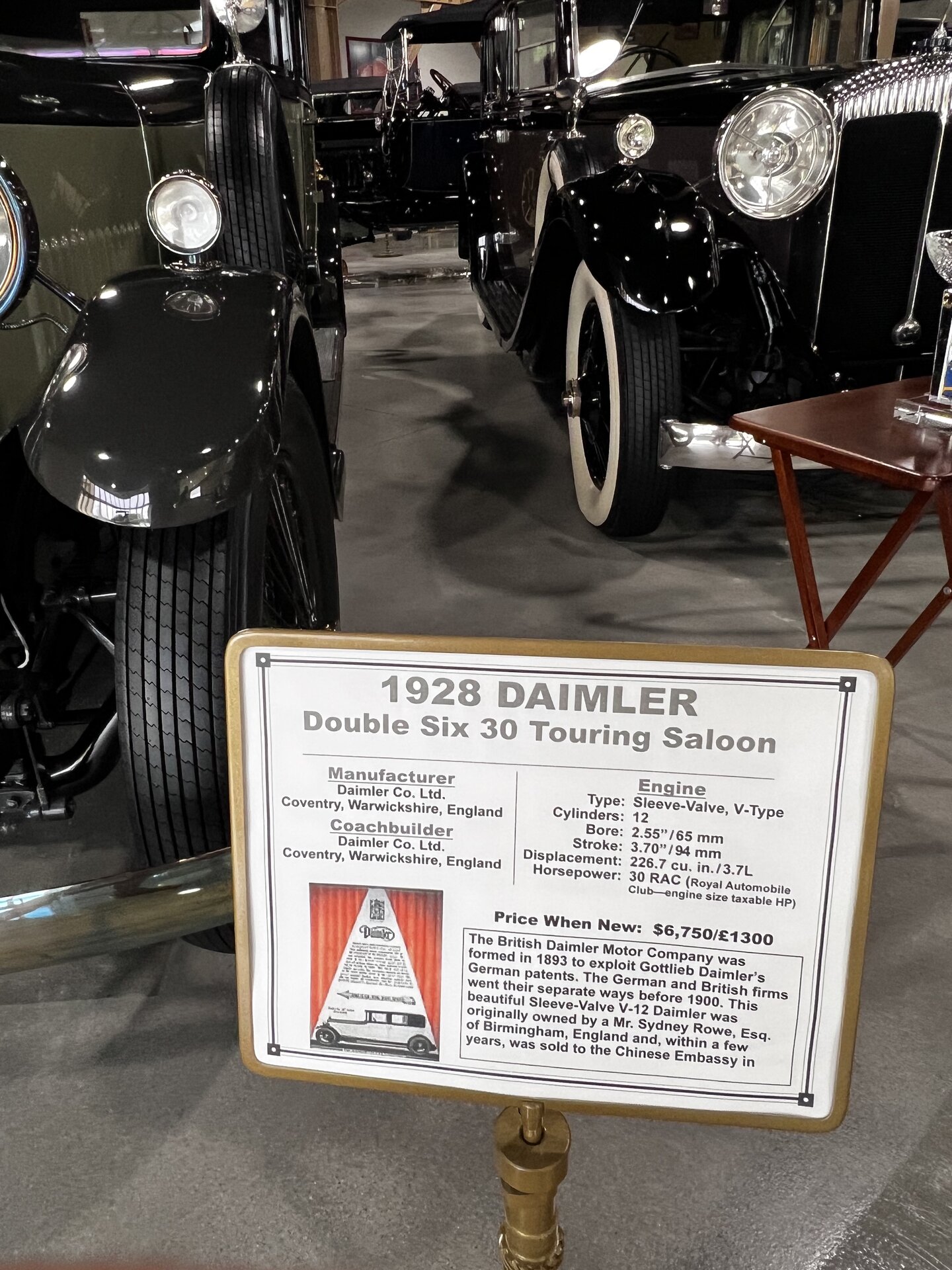
The car in this photograph is the 1928 Daimler Double Six 30 Touring Saloon, one of the most technically unusual luxury cars ever built. It is powered by a Knight-patent sleeve-valve V12 of 30 taxable horsepower and roughly 150 real ones. It was the flagship of the Daimler Motor Company of Coventry, the official supplier to the British royal family, and it is the reason the words Royal Warrant appear on the radiator badge.
The sleeve-valve engine.
Charles Yale Knight, an American publisher turned inventor, patented the double sleeve-valve engine in 1904. Instead of poppet valves opening into the cylinder head, the Knight engine uses two thin steel sleeves that reciprocate between the piston and the cylinder wall. Ports in the sleeves align with intake and exhaust passages at the right moments in the cycle. The mechanism is silent. There are no springs slamming valves shut. There are no lifters ticking. There is no valve float at high rpm. Daimler bought a full manufacturing license in 1908 and built sleeve-valve engines for the next 25 years. The trade-off was oil consumption: the Knight engine burned oil visibly, especially when cold, and left a blue haze behind. To Daimler customers, that was the sound of silence being paid for.
The Double Six.
The Double Six was introduced at the 1926 Olympia Motor Show, the first British production V12. Daimler's engineer Laurence Pomeroy took the existing sleeve-valve straight six and mated two of them at a 60-degree angle onto a common crankshaft. The result: 7,136 cc, 25/85 hp taxable rating in the initial version, 30/150 hp in the later 30 model here. Firing intervals every 60 degrees of crank rotation produced the smoothest torque delivery available in the industry. A well-adjusted Double Six could idle so quietly at a red light that pedestrians did not know the car was running.
Coachbuilt as a Touring Saloon.
Daimler sold the Double Six as a rolling chassis. The specific car in this photograph carries a Touring Saloon body: a formal enclosed body with a sliding division between the chauffeur's compartment and the passenger cabin, seating for six, and coach doors. It was the standard configuration for a customer who employed a driver and wanted the passenger cabin to feel like a small London club room. Body weight added roughly 1,500 pounds over the chassis. Curb weight complete was around 6,000 pounds. Top speed was about 80 mph, which for a two-and-three-quarter ton silent V12 in 1928 was a remarkable number.
The royal warrant.
Daimler had held the royal warrant as official automobile supplier since 1898, when King Edward VII, then Prince of Wales, ordered his first car from them. Every British monarch from Edward VII through Queen Elizabeth II used Daimlers as state cars until Rolls-Royce eventually displaced them in the 1950s. In 1928, when the Double Six 30 was current, King George V had a Daimler. So did Queen Mary. So did most of the British aristocracy that could afford the £2,900 price for a bodied car, roughly $175,000 in today's money.
Why this machine still matters.
A silent, smooth, low-vibration drivetrain in a two-and-a-half-ton passenger cabin is the exact specification of a modern electric luxury car. The Double Six achieved it in 1928 with a Knight sleeve-valve V12. The 2025 Rolls-Royce Spectre achieves it with a battery and two electric motors. Different mechanics, identical experience: the passenger cannot hear the drivetrain, and does not want to. That is the engineering brief. Daimler wrote it a century ago.
"The Double Six was built to a specification the modern electric luxury car copies exactly: passengers should not know a drivetrain exists. Daimler solved the problem with a sleeve-valve V12 in 1928. Everyone else spent the next hundred years catching up."
Omar Mukhtar, field note
Background reading
For further reading: search the public record for 1928 Daimler Double Six 30 Touring Saloon, and visit the Nethercutt Collection, where Omar studied and photographed this material first-hand.
Copyright
Photographs © 2026 Outonomous. All rights reserved. Image rights are held by Outonomous and may not be reproduced without written permission.