Entry 026 · Nethercutt Collection · Field study
Commerce and the Panama Canal, the fifty-mile shortcut that rewired the world.
The Canal cut the New York to San Francisco sea route by 7,800 miles. Building it took 34 years, two countries, 25,000 lives, and the invention of tropical medicine, industrial excavation, and a lock system that still moves the global economy.
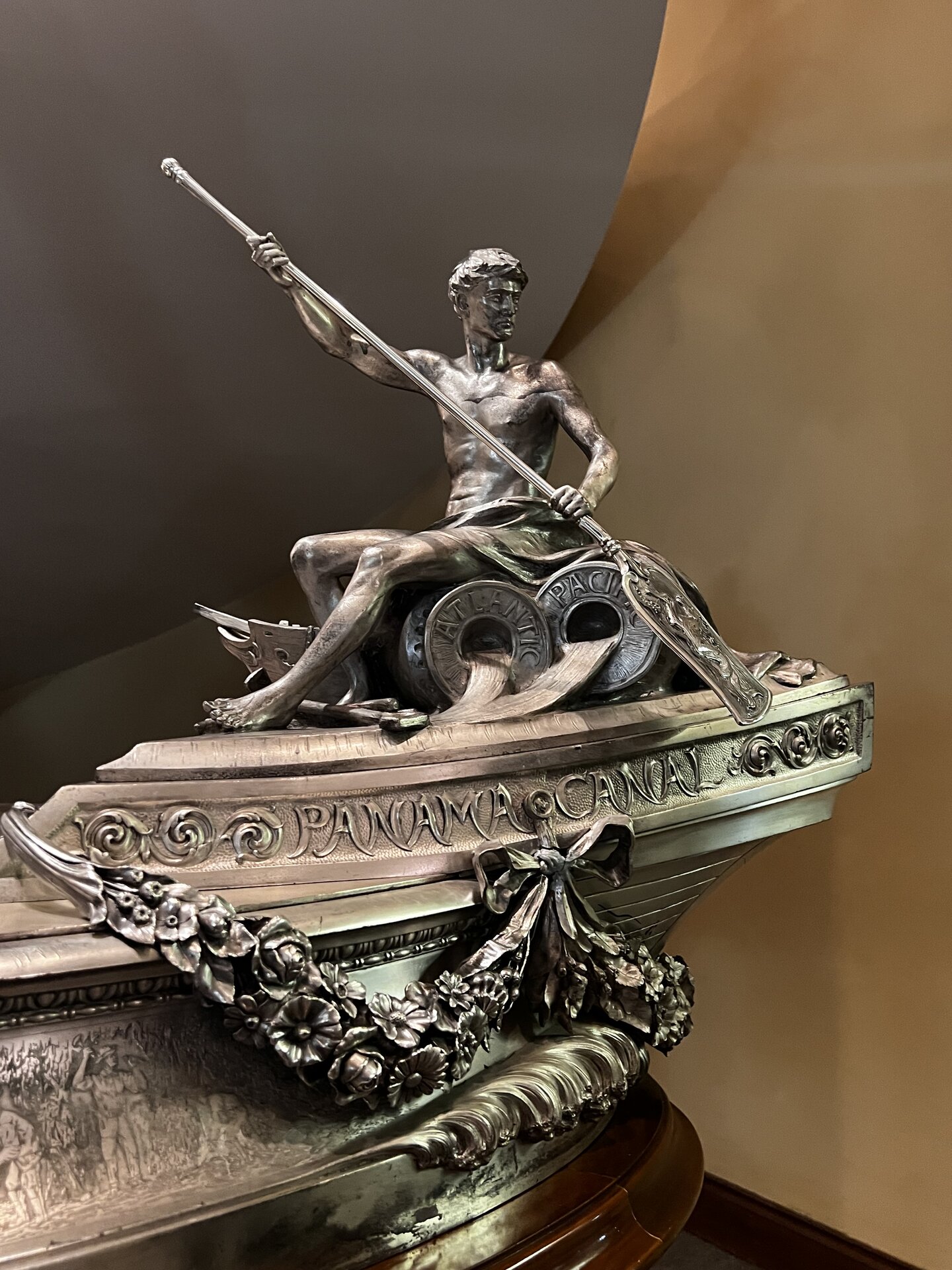
The Panama Canal is 48 miles of engineered water that made the New York to San Francisco sea route 7,800 miles shorter. Building it took two countries, 34 years, roughly 25,000 lives, and the invention of tropical medicine, industrial excavation at continental scale, and a lock system that still moves 6 percent of world trade every year, more than a century after it opened.
The French tried first, and failed.
Ferdinand de Lesseps, the diplomat who built the Suez Canal, arrived in Panama in 1881 with French capital and a plan for a sea-level canal cut straight through the Continental Divide. Suez had been dug through flat desert. Panama was jungle, mountains, and a river that flooded 30 feet in a single storm. Yellow fever and malaria killed workers faster than they could be shipped in. Between 1881 and 1889 more than 22,000 workers died. The Compagnie Universelle du Canal Interocéanique went bankrupt, wiped out 800,000 French investors, and produced one of the largest financial scandals of the 19th century. The sea-level plan was engineering hubris. Panama was going to require locks.
The American takeover.
In 1902 the US Congress authorized the purchase of the failed French assets for $40 million. In 1903, when Colombia refused to ratify the treaty, President Theodore Roosevelt supported a Panamanian independence movement. Panama declared independence on 3 November 1903 and signed the Hay-Bunau-Varilla Treaty with the United States 15 days later, granting the US a 10-mile-wide Canal Zone in perpetuity. Construction resumed under Chief Engineer John Frank Stevens in 1904 and continued under George Washington Goethals from 1907 to opening.
Yellow fever and Dr. William C. Gorgas.
The single most important decision in the American Canal effort was medical. Colonel William C. Gorgas of the US Army had already eliminated yellow fever in Havana by targeting the Aedes aegypti mosquito. He arrived in Panama in 1904 and ran a four-year campaign of screening, drainage, fumigation, and oiling of standing water that eliminated yellow fever from the Canal Zone by 1906 and reduced malaria mortality by an order of magnitude. Without Gorgas the Canal would have failed a second time. Every major public health program of the 20th century, from the Panama Canal Zone forward, is downstream of what Gorgas did.
Locks, not a ditch.
The final American design abandoned the sea-level plan. Instead the Canal uses three sets of locks (Gatun, Pedro Miguel, and Miraflores) to lift ships 85 feet above sea level to Gatun Lake, an artificial reservoir created by damming the Chagres River. Ships transit the lake, descend through the Pacific locks, and exit into the ocean on the other side. Every gate is 82 feet high, 65 feet wide, and weighs 750 tons. Water flow is gravity-fed. No pumps are used. The system has operated continuously since 15 August 1914, 110 years and roughly 1.2 million transits later.
The expansion.
By the 1990s the original locks were too small for modern container ships. Panama financed and completed a $5.25 billion expansion in 2016, opening a third parallel set of Neo-Panamax locks that can accommodate ships up to 1,200 feet long carrying up to 14,000 containers. Panama Canal transit tolls generate roughly $3 billion per year for the Republic of Panama, which took full sovereign control of the Canal on 31 December 1999 under the 1977 Torrijos-Carter Treaties.
Why the Canal belongs in a mobility archive.
A canal is a fixed-infrastructure control system for global commerce. It moves 5 to 6 percent of world seaborne trade through 48 miles of engineered water, with a throughput ceiling set by the locks and a reliability standard measured in decades of continuous operation. Roads are the same class of problem at a much larger scale: 40 million miles of pavement worldwide, 1.6 billion vehicles, and no coordinated control layer. The Panama Canal proves what a well-designed control layer buys you: a century of throughput at planetary scale. That is the argument Outonomous makes for the road network. Install the missing intelligence layer and the throughput compounds.
"Panama shows what a well-engineered control layer does to commerce. Forty-eight miles of water rerouted the planet. The road network is the next canal. It just needs its own control layer."
Omar Mukhtar, field note
Background reading
For further reading: search the public record for Panama Canal, and visit the Nethercutt Collection, where Omar studied and photographed this material first-hand.
Copyright
Photographs © 2026 Outonomous. All rights reserved. Image rights are held by Outonomous and may not be reproduced without written permission.