Entry 022 · Nethercutt Collection · Field study
Cadillac, when a new American company set the world standard for precision.
In 1908 Cadillac stripped three cars in England, mixed the parts, rebuilt three running cars, and drove them 500 miles. The Royal Automobile Club awarded the Dewar Trophy and coined the phrase Standard of the World.
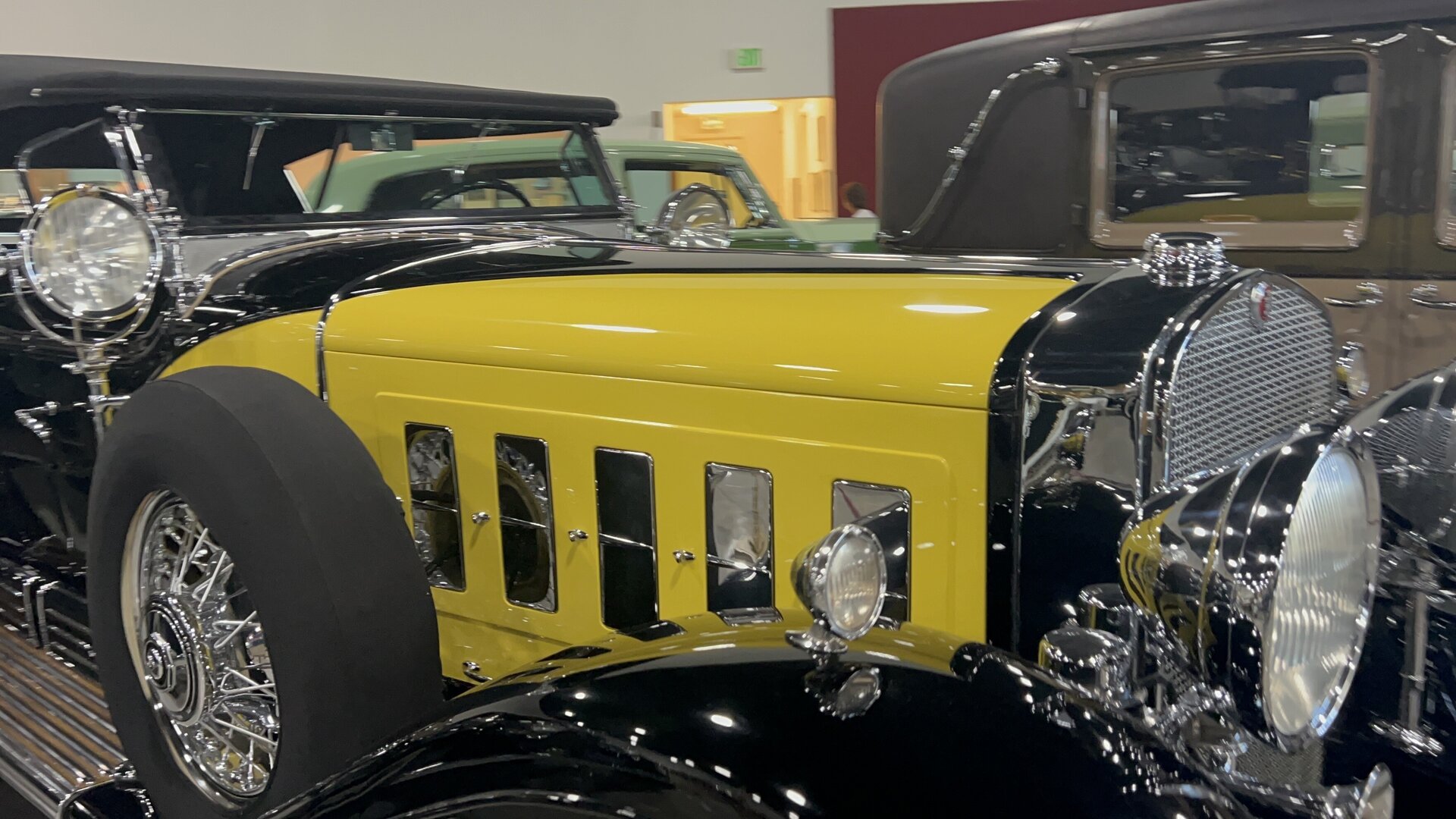
In 1908 a young American car company called Cadillac shipped three of its Model K runabouts to England, tore all three of them down to individual parts in front of the Royal Automobile Club, mixed the parts together on the floor of the Brooklands garage, and then rebuilt three running cars from the pile. Two of them were driven 500 miles at speed. All three finished. The RAC awarded Cadillac the Dewar Trophy and coined the phrase "Standard of the World." At the time, Cadillac was six years old.
Henry Leland, precision toolmaker.
Henry Martyn Leland was a machinist trained at the Springfield Armory and the Colt firearms factory. He learned to make interchangeable parts to a tolerance of 0.001 inch at a time when the automobile industry was still hand-fitting components. In 1902 he was called in as a consultant when the Henry Ford Company collapsed. Leland took the assets, renamed the company Cadillac after the French officer who founded Detroit, and put his precision manufacturing method to work on a single-cylinder runabout. The 1903 Cadillac Model A had interchangeable parts. That was already unusual.
The 1908 Dewar Trophy trial.
The Royal Automobile Club's Dewar Trophy was the most prestigious engineering award in the automobile industry. To win it in 1908 Cadillac's British importer, Frederick Bennett, proposed a test no other manufacturer would attempt. Three Cadillac Model Ks were selected at random from dealer stock. Under RAC observation the three cars were completely disassembled into 721 individual components each. The parts were mixed on the garage floor at Brooklands. Then, using only common wrenches, three cars were rebuilt from the mixed pile. Two of the rebuilt cars were driven 500 miles at Brooklands. All three ran perfectly. In an industry where every component was hand-fitted to its specific mating part, this was almost incomprehensible.
Standard of the World.
The RAC awarded Cadillac the Dewar Trophy on 27 February 1909. The advertising copywriters at Cadillac coined the phrase "The Standard of the World" and put it on every subsequent product and advertisement for the next 100 years. It was earned. In 1908 Cadillac had proven publicly that an American car company could manufacture to a precision that the European industry could not match. That established the American automobile as an engineering peer to Europe, not a scrappy provincial cousin, and it did so eight years before Ford's moving assembly line and 20 years before the American luxury boom of the late 1920s.
The second Dewar Trophy.
Cadillac won the Dewar Trophy a second time in 1913 for the introduction of the electric self-starter, developed by Charles F. Kettering at Delco. The self-starter was the single most important safety innovation in the history of the automobile: it eliminated the hand crank, which had been breaking wrists and killing operators for a decade. Cadillac is the only manufacturer to have won the Dewar Trophy twice. In 1912 the Cadillac Model Thirty was the first production car in the world with electric start, electric lights, and an electric ignition system. Every car built since is descended from that specification.
Why the early Cadillac mattered.
The early Cadillac was not luxurious in the Duesenberg sense. It was correct in the machinist sense. Henry Leland was building cars the way he had built rifles: to a tolerance, to a standard, with parts that could be swapped between examples without hand-fitting. That discipline, more than any specific model, is what created the American automobile industry as an engineering culture rather than a coachbuilding culture. Every General Motors car built since 1908 carries some inheritance from what Leland proved at Brooklands. Every Toyota, every Volkswagen, every Hyundai carries the same inheritance one step further down the line.
The through-line.
Interchangeable parts at 0.001-inch tolerance in 1908 is the same intellectual move as software modularity at nanosecond timing in 2026. Both are arguments that a physical system should be built from components that meet a specification precisely enough to be swapped without hand-fitting. That is the argument Outonomous makes for the intelligence layer on the installed base: build the perception, prediction, and control layer to a specification tight enough that it can be dropped onto any of the 1.6 billion vehicles already on the road. Cadillac proved it works in metal. The next century of Physical AI has to prove it works in software.
"Three cars, disassembled, mixed, rebuilt, driven 500 miles. That was 1908. Cadillac earned the phrase Standard of the World the honest way: publicly, under observation, in the country whose engineering culture the American industry was trying to catch."
Omar Mukhtar, field note
Background reading
For further reading: search the public record for early Cadillac, and visit the Nethercutt Collection, where Omar studied and photographed this material first-hand.
Copyright
Photographs © 2026 Outonomous. All rights reserved. Image rights are held by Outonomous and may not be reproduced without written permission.