Entry 018 · Nethercutt Collection · 1931
The 1931 Bugatti Type 51 Dubos, the car Louis Chiron drove and modern Bugatti named the Chiron after.
Twin-cam straight eight, supercharged, built on the bones of the Type 35. Louis Chiron won grand prix after grand prix in cars like this one. A century later the marque put his name on its flagship.
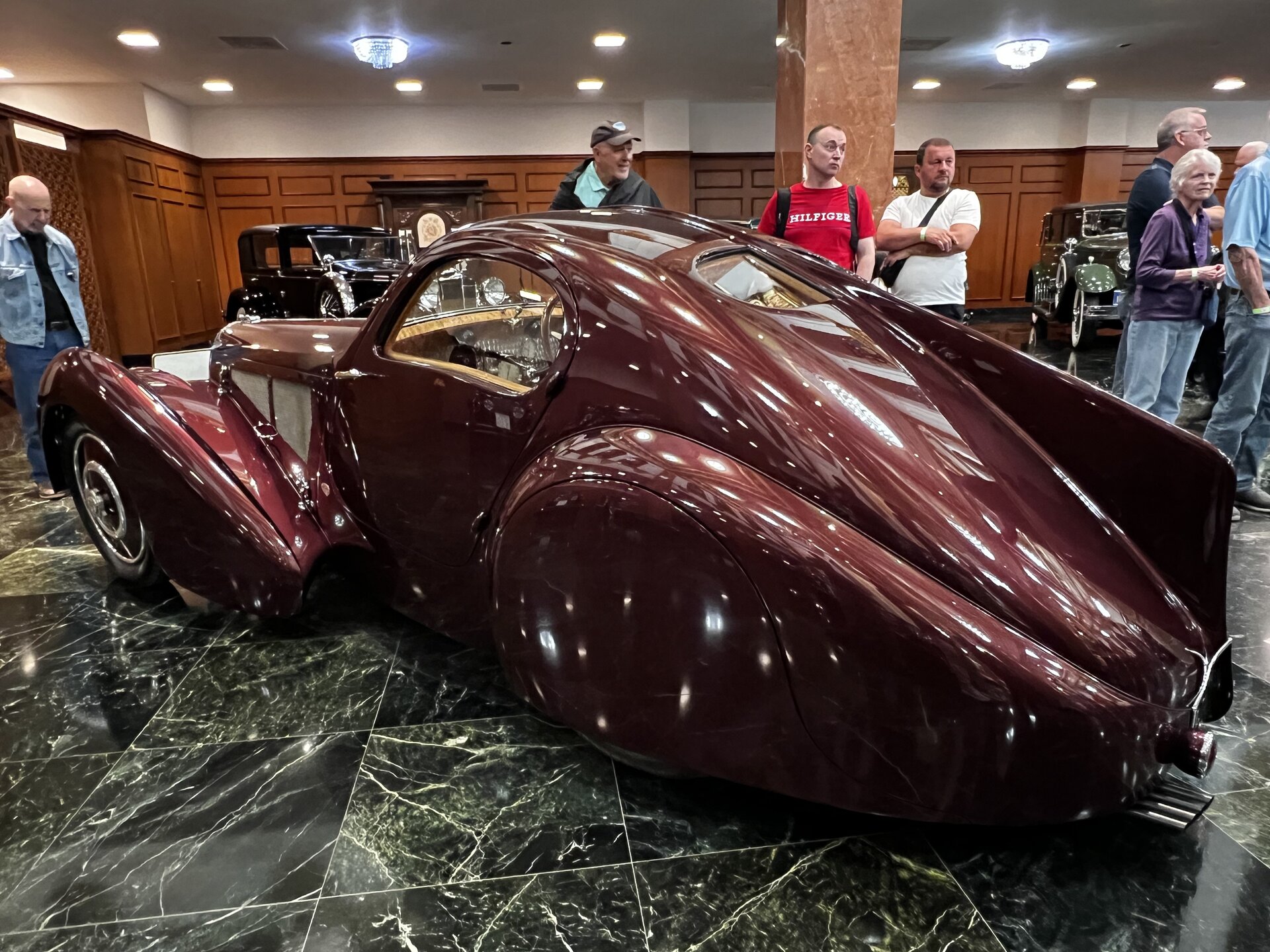
This is a 1931 Bugatti Type 51 with a coachbuilt body by Dubos of Paris. The Type 51 was Ettore Bugatti's answer to twin-cam competition in grand prix racing, and its most successful driver was Louis Chiron, the Monegasque who won grand prix after grand prix in cars like this one from 1931 to 1934. Ninety-two years later, in 2016, Bugatti launched its 1,500-horsepower flagship road car and named it the Chiron, after the same driver. The name Chiron on a modern hypercar leads directly back to this chassis.
The Type 51.
The Bugatti Type 51 was introduced in 1931 as the successor to the legendary Type 35, the most successful grand prix car of the late 1920s. Ettore Bugatti's son Jean drove the redesign. The Type 35's single-overhead-cam straight-eight was replaced with a twin-cam version producing 160 to 180 horsepower from 2,300 cc, supercharged, running to 5,500 rpm. The chassis kept the Type 35's cast-aluminum wheels (still one of the great aesthetic choices in racing history), horseshoe radiator, and tapered tail. Between 1931 and 1935 Bugatti built approximately 40 Type 51 chassis. They dominated grand prix racing in the first half of the 1930s, winning at Monaco, Belgium, Czechoslovakia, and dozens of second-tier events.
Louis Chiron.
Louis Chiron was born in Monaco in 1899 and became the most successful French-speaking racing driver of the pre-war era. He drove for Bugatti from 1928 to 1933 and again in the late 1940s. He won the French Grand Prix, the Italian Grand Prix, the Spanish Grand Prix, the Czech Grand Prix, the Monaco Grand Prix, and the Nice Grand Prix, most of them in a Bugatti. He was still racing in Formula One in his 50s and completed his last Monaco Grand Prix in 1955 at age 55, still the oldest driver ever to start a Formula One race. He died in Monaco in 1979.
The Dubos body.
Most Type 51s were bodied at the Bugatti factory in Molsheim as open-wheel grand prix cars. A small number of chassis were sold as bare rolling frames to private coachbuilders who dressed them as road-going sports cars. Charles Dubos of Paris was one of those coachbuilders. A Dubos-bodied Type 51 kept the racing chassis and engine but gained fenders, running boards, and a road-legal windscreen. It is one of the most beautiful ways any Type 51 was ever bodied, and it makes the racing intent underneath the coachwork visible from every angle.
The name lives on.
When Volkswagen Group revived Bugatti in 1998 the modern flagship was named the Veyron, after Pierre Veyron, the Bugatti works driver who won Le Mans in 1939. In 2016 the successor was named the Chiron, after Louis. The 2016 Bugatti Chiron is a 1,500-horsepower quad-turbocharged W16 hypercar with a top speed limited to 261 mph, priced at around $3 million. The Chiron Super Sport 300+ became the first production car in history to break 300 mph in 2019. Its name is on the flank of every one of them: Chiron. The reference is exactly this car and this era.
Why Bugatti did it this way.
Bugatti as a modern brand runs on continuity with pre-war grand prix racing. The horseshoe grille, the model naming, the two-tone paint, the raised C-pillar, the interior detailing all reach back to Molsheim in the 1930s. Naming the flagship after Louis Chiron was not a marketing decision. It was a company statement about what Bugatti still is. The Chiron on the wall in this Nethercutt display is where that story starts, on a real Type 51 chassis that Louis Chiron's colleagues actually raced.
The through-line.
Names, like ornaments, outlast machinery. Louis Chiron was a driver in a supercharged 2.3-liter grand prix car in 1932. His name is now on a 1,500-horsepower hybrid W16 in 2025. Ninety-plus years of continuity in the automotive industry is extremely rare. The lesson at Outonomous is that the identity of a machine can persist through complete replacement of its drivetrain, its aerodynamics, and its intelligence layer. Only the story has to hold.
"A Monaco-born grand prix driver from 1928 gave his name to the fastest road car on Earth in 2025. That is what happens when a machine earns its story. The name outlives every part of the car it was first written on."
Omar Mukhtar, field note
Background reading
For further reading: search the public record for 1931 Bugatti Type 51 Dubos, and visit the Nethercutt Collection, where Omar studied and photographed this material first-hand.
Copyright
Photographs © 2026 Outonomous. All rights reserved. Image rights are held by Outonomous and may not be reproduced without written permission.