Entry 017 · Nethercutt Collection · 1951
The 1951 Bentley Mark VI Coupe DeVille by Franay, the one-off Aristotle Onassis bought for his wife Tina at the Paris Salon.
A one-off Bentley Mark VI chassis, bodied by Franay Frères in Paris, shown at the 1951 Paris Salon, and bought off the stand by Aristotle Onassis as a gift for his wife Athina 'Tina' Livanos. In the Nethercutt Collection since 1969.
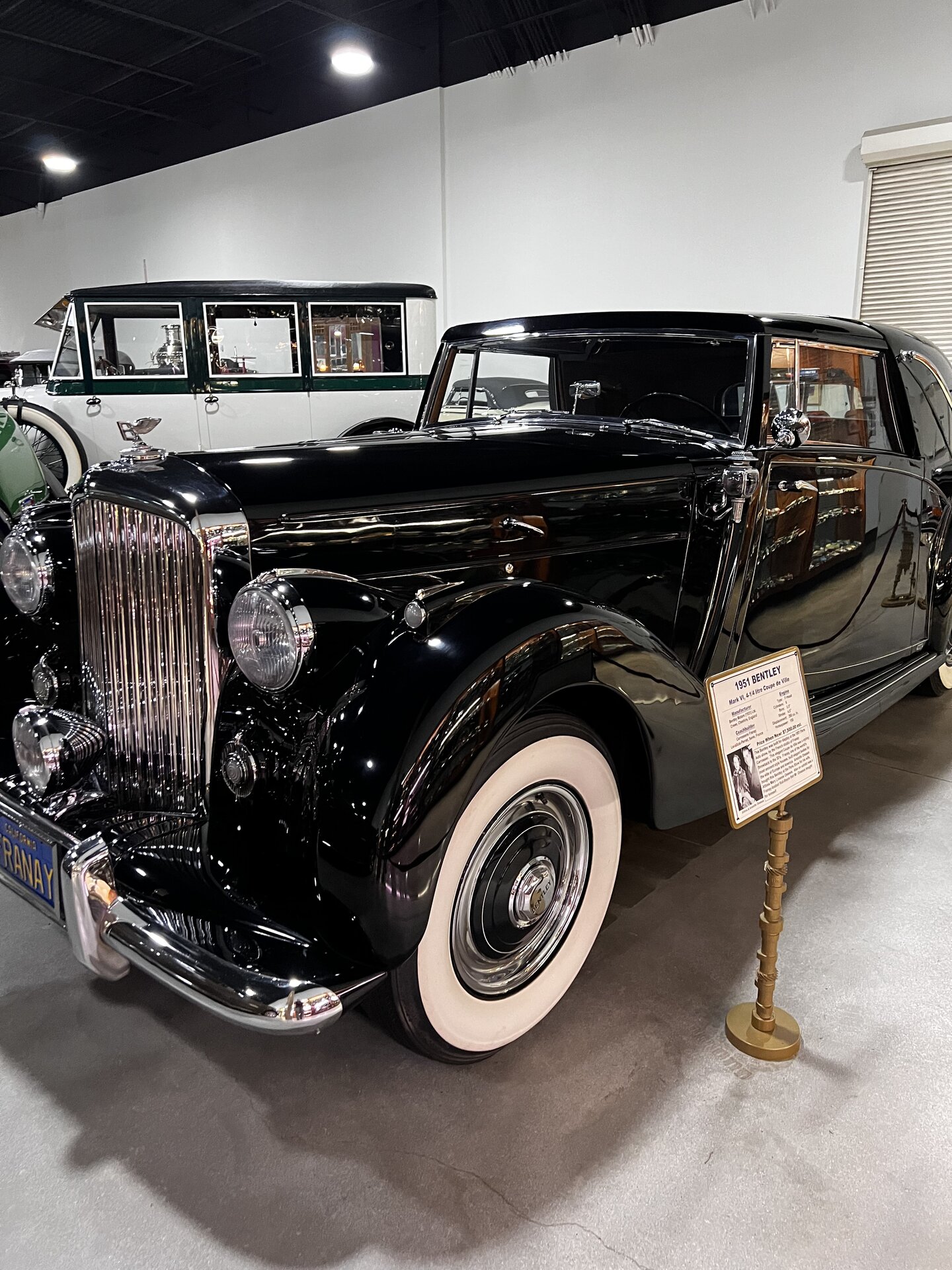
This is a 1951 Bentley Mark VI Coupe DeVille, one-off coachwork by Franay Frères of Levallois-Perret, Paris. The chassis was commissioned directly by Rolls-Royce as a show car for the 1951 Paris Salon, where the completed car was displayed as the best-built, best-handling car Rolls-Royce Bentley had ever produced. Aristotle Onassis bought it off the stand for his wife Athina "Tina" Livanos. It sold new for $7,500, has been in the Nethercutt Collection since 1969, and the odometer reads about 64,550 miles.
Why the Mark VI matters before we even get to this one.
The Mark VI was the first postwar Bentley and the first Rolls-Royce/Bentley product built at Crewe, in the aero-engine factory that had spent the war building Merlin V12s for the Spitfire, Hurricane, Lancaster, and Mustang. It was also the first Bentley Rolls-Royce sold as a complete car with a factory "standard steel" body from Pressed Steel Company, instead of only a rolling chassis. That single decision, that Bentley would deliver a finished car, is the industrial pivot that ends the classical coachbuilding era in England. From 1946 onward the customer no longer had to commission a body to own a Bentley.
The Mark VI kept the option open, though. The rolling chassis was still available to serious coachbuilders, and roughly 20% of the 5,201 Mark VIs built between 1946 and 1952 wore custom bodies by Park Ward, H.J. Mulliner, Hooper, James Young, Freestone & Webb, Graber, and Franay. This car is one of that 20%. It is also one of only seven Mark VI chassis Franay bodied across the entire 1946 to 1952 run.
Franay Frères, and why Rolls-Royce commissioned them.
Franay was a Paris carrossier founded in 1903 by Jean-Marie Franay and continued by his sons Louis and Marius. By 1951 they were one of the last serious French coachbuilders still capable of full one-off bodies to Rolls-Royce and Bentley chassis standards. Rolls-Royce wanted a car on the Franay stand at the Paris Salon that could argue two things at once: that the Crewe chassis was the best platform in the world for bespoke coachwork, and that French style could still be draped over English mechanicals without either side losing an argument.
The result was this Coupe DeVille. "Coupe DeVille" in the coachbuilding sense is not the postwar Cadillac trim name. It is the older French idea: a driver's compartment open or semi-open to the sky while the passenger compartment behind is fully enclosed and formal. Franay updated the type. The roof over the front seats is a cabriolet-style hardtop with a retractable front section that opens the sky above the driver. The rear roof is fixed, with closed rear quarter panels and no rear side windows behind the passenger door. It is a chauffeur car dressed as a personal coupe, and it makes sense the instant you understand who bought it.
Aristotle Onassis, at the Paris Salon, in 1951.
In 1951 Aristotle Onassis was 45 years old and already one of the wealthiest men in Europe. His shipping fleet ran under Panamanian and Liberian flags, he had bought his first surplus American tankers in 1946, and he was about to launch the two supertankers, Tina Onassis and Al-Malik Saud Al-Awal, that made him a global figure. He had been married since 1946 to Athina "Tina" Livanos, daughter of Stavros Livanos, the biggest Greek shipping family of the generation before his. She was 22 in 1951. The Onassises lived between Paris, Monte Carlo, and the yacht Christina O.
The Paris Salon opened at the Grand Palais in October. Onassis bought the Franay Bentley off the show stand, as a gift for Tina, and had it delivered. It was exactly the kind of object that made sense for that marriage in that year: a one-off body on the best mechanical chassis in the world, from the last serious French carrossier, chosen at the most important motor show in Europe, in a configuration that assumed a driver up front and privacy in the back. It was not a car for the man to drive. It was a car for the wife to be seen arriving in.
The mechanical package under the Franay body.
The early Mark VI used the 4,257 cc inlet-over-exhaust ("F-head") straight-six with a single Stromberg carburetor. From mid-1951 Crewe enlarged it to 4,566 cc for better torque at low revs and easier flexibility in city traffic, with output quoted at about 150 horsepower, though Rolls-Royce famously refused to publish precise power figures and described the output as "adequate." Transmission is a four-speed manual with synchromesh on second, third, and fourth. Chassis is a separate steel frame with independent coil-and-wishbone front suspension and a live rear axle on leaf springs. Brakes are drums at all four corners, hydraulic at the front and mechanical at the rear through the Rolls-Royce servo driven off the gearbox, the same servo design used on Silver Wraiths and Phantoms.
The point of that package under a Franay body is that the buyer gets Rolls-Royce mechanical discipline, refined enough to run all day at 80 mph across France, wrapped in a body no one else in the world owns. That was the entire argument of the coachbuilt Bentley: the mechanicals were shared with the boss's own Silver Dawn, the body was yours alone.
Reading the object first-hand.
Standing next to this car at the Nethercutt, the thing that lands is proportion. The hood is long because the straight-six sits fully behind the front axle, so the crank centerline is roughly at the base of the windscreen. The greenhouse is short because Franay pulled the roofline down over the rear passengers to protect their privacy. The rear quarter is deliberately blind, no side glass past the door, which is what a chauffeured passenger of 1951 wanted: seen from outside as a silhouette, not a face. The retractable front roof panel is the concession to the owner-driver mode; on a warm afternoon in Monaco you slide it back and drive the car yourself, and the rear stays formal.
The other detail that only shows up in person is finish. Franay's coachwork is a hand-formed steel body over an ash frame, leaded and filed by hand at the seams, and the reflections along the fenders are continuous instead of broken. That is the visible signature of pre-industrial body making: a body built by fitting and filing, not by stamping and welding. It is the last generation where that method was still economically defensible on a road car, and it is the reason Rolls-Royce commissioned this exact body from this exact house for this exact show.
The line to Outonomous.
I keep coming back to this car because it makes the platform-versus-body distinction almost too obvious. The Bentley Mark VI chassis is the platform. Franay Frères are the body. Onassis is the buyer. Tina is the user. The chassis was designed to accept many different bodies for many different lives, and the same rolling chassis in 1951 was also a Park Ward drophead, an H.J. Mulliner saloon, a Hooper Empress, and a Franay Coupe DeVille for a Greek shipping magnate's wife. One platform, many upgrades, many owners, many decades.
That is the exact model Outonomous is building for the installed base. The 1.6 billion vehicles already on the road are the chassis. The perception, prediction, and control stack is the body. The mission, 100 million lives saved, is the reason to do the work. This Franay Bentley is a receipt from 1951 that platforms outlive their first body, first owner, and first purpose. In seventy-five years the chassis under it has carried Onassis money, changed hands, entered a California collection, and is still being read by people like me who came to see what a coachbuilt one-off actually looks like in the room. The physical vehicle is the durable layer. Everything on top of it is upgradeable. That is the whole argument.
"Rolls-Royce commissioned it. Franay bodied it. Onassis bought it for his wife off the Paris Salon stand. One chassis, one body, one buyer, one gift. Seventy-five years later I photographed it, and the point of the object is still legible: the platform is the durable thing, the body is the story."
Omar Mukhtar, field note
Background reading
For further reading: search the public record for 1951 Bentley Mark VI Coupe DeVille by Franay, and visit the Nethercutt Collection, where Omar studied and photographed this material first-hand.
Copyright
Photographs © 2026 Outonomous. All rights reserved. Image rights are held by Outonomous and may not be reproduced without written permission.