Entry 016 · Nethercutt Collection · 1926
The 1926 Bugatti Type 23 Brescia Cabriolot, 'Baby Bugatti' as a term of endearment.
The 'Baby Bugatti' nickname is affectionate because modern Bugattis like the Veyron and Chiron are heavy, turbocharged hypercars. This 1926 Type 23 Brescia Cabriolot is the light, small, elegant ancestor they are measured against.
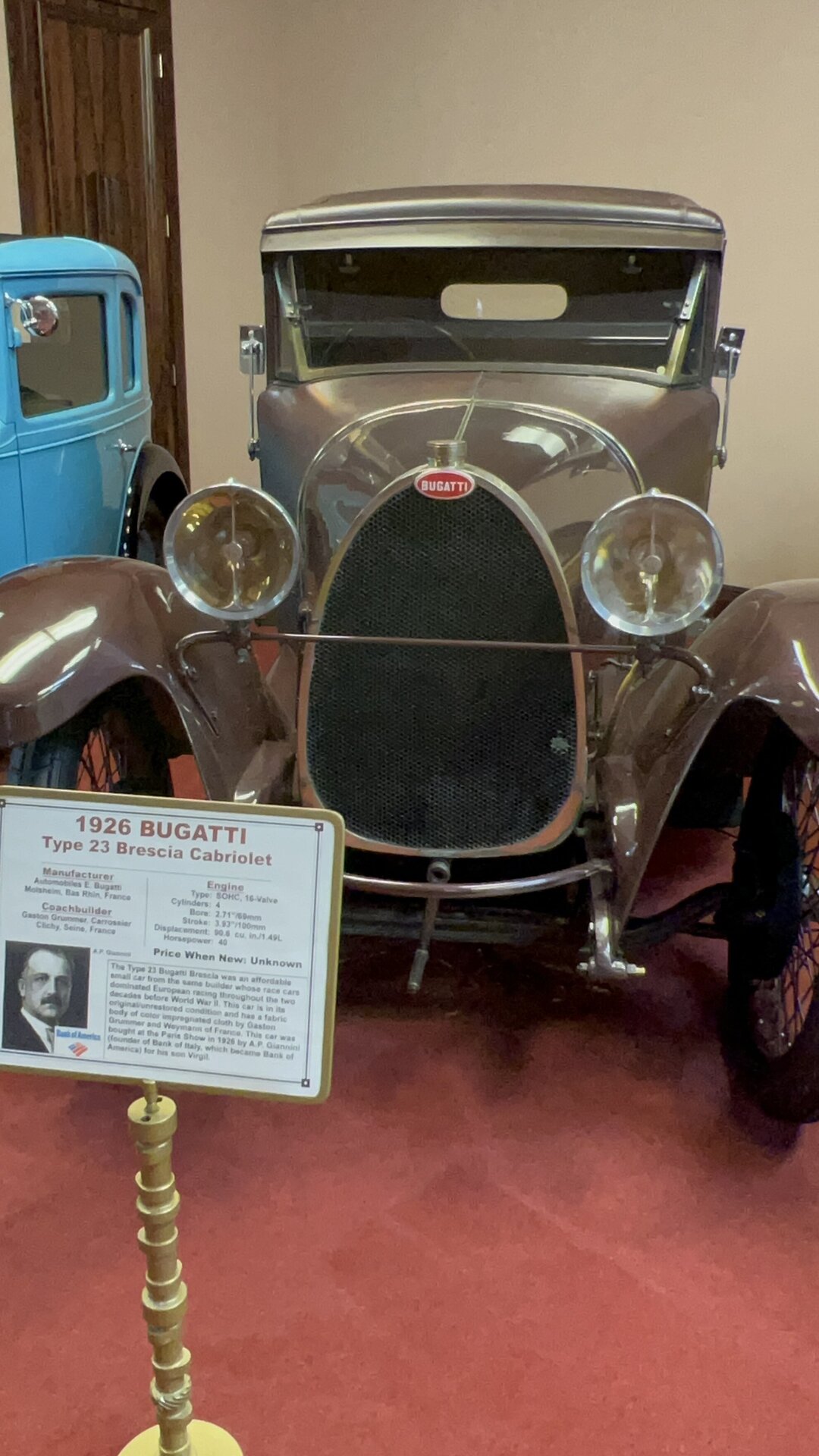
The nickname "Baby Bugatti" only makes sense once you have seen what a modern Bugatti is. A Bugatti Veyron or Chiron is a heavy, turbocharged monument to power: four-digit horsepower, more than two tons of carbon and titanium, and a top speed that only makes sense on a closed track. The 1926 Bugatti Type 23 Brescia Cabriolot in this photograph is the opposite. It is small, light, and driven by a 1.5-liter overhead-cam four. That contrast is why people call it Baby Bugatti. It is the beloved little ancestor of a family that later grew into giants.
Modern Bugatti is a different species.
The Bugatti of the twenty-first century is defined by the Veyron 16.4 and the Chiron. The Veyron arrived in 2005 with an 8.0-liter quad-turbocharged W16, four driven wheels, and a curb weight over 1,800 kilograms. It was the first production car to clear 1,000 metric horsepower, and it needed a top-speed key, a special targa, and its own Michelin tires to do it. The Chiron pushed that further: 1,500 metric horsepower from a redesigned W16, active aerodynamics, and a dry weight still near two tons. These are cars built to prove that extreme engineering and extreme luxury can coexist at the limit of physics. They are not delicate. They are not small. They are land-bound aircraft, and they are the reason a 1926 Brescia looks like a baby by comparison.
The Type 23 Brescia.
The Bugatti Type 23 was introduced in 1923 as a refined version of the Type 22 and, before it, the Type 13. All three share the same foundational architecture: a small, light, high-revving inline-four with a single overhead camshaft driven by a vertical shaft at the front of the engine. The Type 23 displaced 1.5 liters, produced around 70 horsepower in standard tune, and sat on a 2,550-millimeter wheelbase. That is the same 1.5-liter class Bugatti campaigned at the 1921 Brescia Grand Prix, where it swept the first four places and earned the "Brescia" name forever.
Cabriolot bodywork.
A Cabriolot is a two-seater convertible with a light, folding top and no pretense of limousine comfort. On a Type 23 chassis it is an honest body for an honest car: two seats, minimal weather protection, exposed wheels, and a tapered tail that emphasizes the rear axle. The body was not built by Bugatti itself in every case; several Paris coachbuilders supplied variations, and the cars sometimes left Molsheim as bare chassis for a local coachbuilder to finish. The result is a small, fast, open car that looks like a scaled Type 35 but is actually a road car with racing blood.
Lightness before lightness was a slogan.
Ettore Bugatti's design philosophy was always about reducing mass before adding power. The Type 23 used hollow forged front axles, cast-aluminum wheels, and a compact engine block that was light enough to reach high rpm. The whole car weighed well under 900 kilograms. In 1926, when a Bentley or a Duesenberg was approaching two tons, the Type 23 Brescia was half the weight and twice the agility. It could not match a supercharged 4.5-liter grand prix car in straight speed, but it needed far less road, less brake, and less fuel to do its job.
Why the name is affectionate.
"Baby Bugatti" is a human nickname, not a factory designation. It only works because the modern Bugatti is so large and so powerful that a tiny 1926 ancestor looks like a miniature version of the same idea. The affection is in the comparison: the little car is recognizably from the same family, yet it asks so much less of the road and the driver. It is small enough to feel approachable, beautiful enough to invite affection, and serious enough to wear the Bugatti badge without apology. That emotional bond is real, and it is not a weakness. It is one of the reasons the automobile survived so many competing transportation technologies.
The through-line.
The 1926 Bugatti Type 23 Brescia is a compact, high-quality machine that punched above its displacement. At Outonomous we think about the same ratio in reverse: the planet's 1.6 billion existing vehicles are not small, but they are already deployed, already trusted, and already personal to their owners. The goal is not to replace them with a new fleet of beautiful objects. It is to add the missing perception, prediction, and control layer that turns the installed base into autonomous machines. The affection people feel for a well-built car is not an obstacle to autonomy. It is the reason autonomy has to work with the fleet they already have.
"Baby Bugatti is not a toy. It is a real Bugatti given a pet name because the modern ones are so heavy and so powerful that this little ancestor looks like a miniature. The affection is the point. Machines that earn names are machines that earn trust."
Omar Mukhtar, field note
Background reading
For further reading: search the public record for 1926 Bugatti Type 23 Brescia Cabriolot, and visit the Nethercutt Collection, where Omar studied and photographed this material first-hand.
Copyright
Photographs © 2026 Outonomous. All rights reserved. Image rights are held by Outonomous and may not be reproduced without written permission.