Entry 011 · Nethercutt Collection · 1956
The 1956 Porsche 356A 1600 Coupe, the car that made Porsche Porsche.
The 356A of 1956 was the first fully sorted Porsche. A pushrod flat-four air-cooled 1.6 liter, curved one-piece windshield, torsion bar suspension, unibody steel construction, and less than 1,700 pounds. It set the template every 911 has followed since.
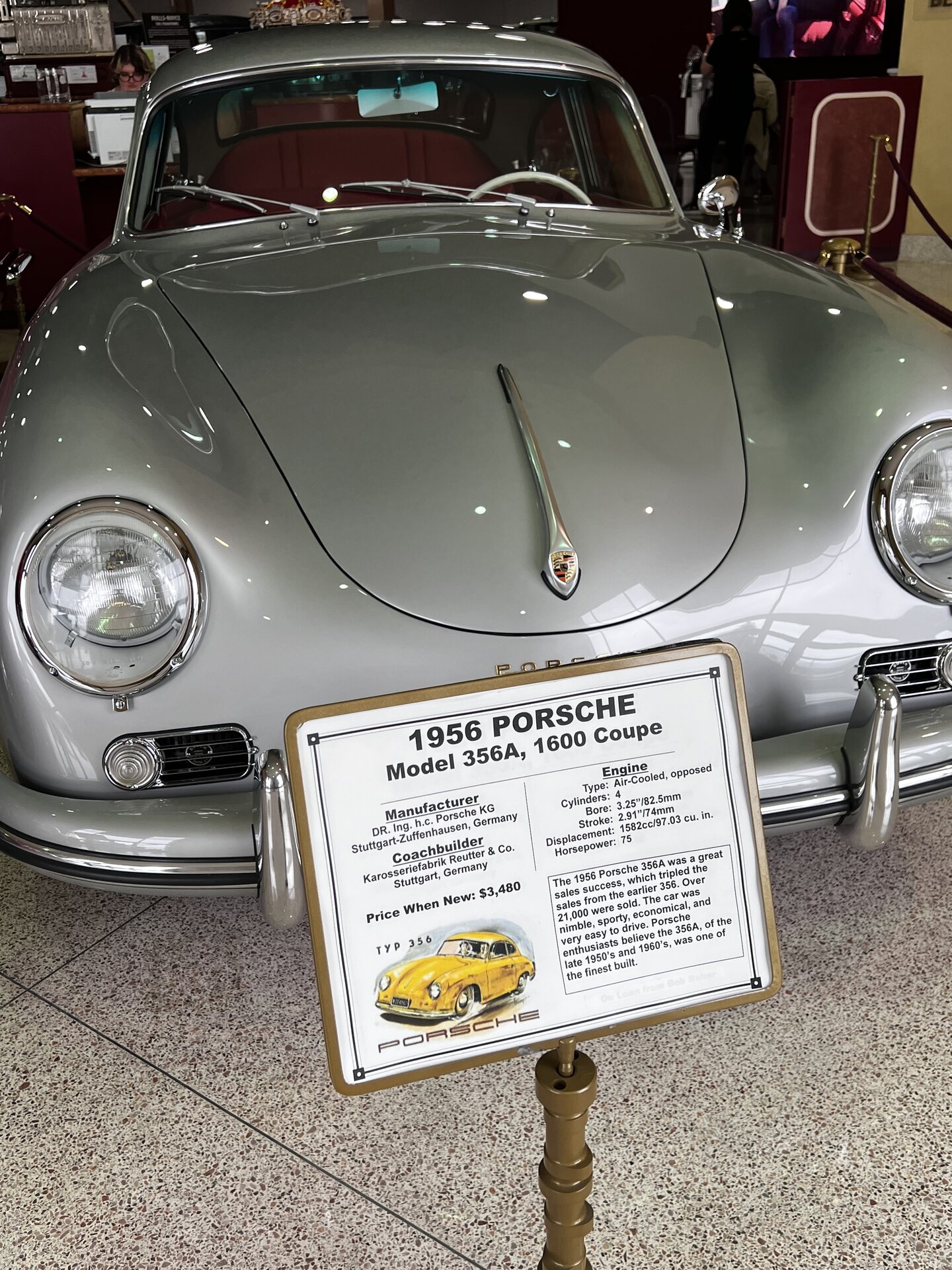
This is a 1956 Porsche 356A 1600 Coupe. It is the car that made Porsche Porsche. The 356 had been in production since 1948 as Ferdinand "Ferry" Porsche's first road car under his own name, but the 356A of 1955 to 1959 is the first version that was fully sorted: curved one-piece windshield, torsion bar suspension dialed in, a proper 1.6 liter pushrod flat-four in place of the old 1.5, and the interior finally treated as a place a driver would want to spend a long day. Every 911 that followed is a direct descendant of this shape, this layout, and this discipline.
From Gmünd shed to Stuttgart production car.
The first 356 was hand-built in a converted sawmill in Gmünd, Austria in 1948, aluminum-bodied, mid-engine, using Volkswagen Beetle mechanicals that Ferdinand Porsche Sr. had designed a decade earlier. By 1950 production had moved to Zuffenhausen outside Stuttgart, the body had been switched to steel, and the engine moved behind the rear axle where it would stay in every 911 for the next seventy-five years. The 356 was in production from 1948 to 1965. Total build across all variants: about 76,000 cars. It is what paid for everything Porsche has done since.
Why the 356A is the one that matters.
The pre-A cars had a two-piece split windshield with a center bar, a legacy of tooling limits. The 356A introduced in late 1955 dropped that for a single curved pane of glass and cleaned up the dashboard, the steering wheel, the pedal box, and the suspension geometry. Displacement went from 1,488 cc to 1,582 cc. The 1600 Normal in this car makes 60 horsepower. The 1600 Super version makes 75. Curb weight is around 1,675 pounds. Top speed for the 60 hp car is about 100 mph. For a 1956 car under $4,000 in the United States, running on regular pump gas, that was genuinely astonishing.
The template every 911 still follows.
Rear-mounted, air-cooled, horizontally opposed engine. Rear-wheel drive. Torsion bar suspension. Unibody steel construction. Low frontal area. Light overall mass. Compact wheelbase. A driver seated close to the front axle with the mass of the engine behind them. That layout was defined here. The 911 launched in 1963 as the 356's replacement and inherited every one of those decisions. The Porsche brand identity, that a small, light, rear-engined coupe driven with precision beats a bigger car driven with brute force, was crystallized in the 356A. Fifty years of 911s are variations on a theme first made coherent in 1956.
What the car proved about mass and control.
Porsche's original argument was not about horsepower. It was about the honesty of a light car. A 1956 356A weighs less than a modern Mazda Miata. It has skinny tires, unassisted steering, drum brakes at all four corners, and 60 horsepower. Driven correctly it is faster point-to-point on a real road than most modern sports cars because nothing between the driver's hands and the road surface is being filtered or interpreted by software. The steering loads up as the front tires load up. The chassis rotates because the mass is where it is, not because a computer allowed it to. That is the feel every subsequent Porsche engineer has been trying to preserve while the cars got heavier, wider, faster, and more electronic.
The competition history.
The 356 won its class at Le Mans in 1951 on debut. It won the Liege-Rome-Liege rally. Porsche's works and privateer cars used the 356A as the basis for the Carrera GT variant with the four-cam Ernst Fuhrmann engine that later powered the 550 Spyder that killed James Dean. The 356A in the standard 1600 form was also the car that established Porsche as a genuine club-racing weapon in the United States, particularly on the West Coast, and built the enthusiast base that made the 911 an instant commercial success in 1963.
Why this car is in the archive.
Because it is one of the very small number of production cars where you can point to a single generation and say: this is where the brand's engineering identity became permanent. The 356A is that generation for Porsche. Everything before it was prototype. Everything after it is refinement. Outonomous is built on the same idea in the opposite direction, that the platform underneath the vehicle is the identity that matters and can carry a hundred years of upgrades. Porsche proved it in one direction by holding the layout constant while everything else improved. The installed base proves it in the other direction. The chassis is the constant. The intelligence is the upgrade.
"The 356A is the moment Porsche stopped being a workshop and became a discipline. Everything after it, including every 911 you have ever seen, is a variation on decisions that were finalized in 1956."
Omar Mukhtar, field note
Background reading
For further reading: search the public record for 1956 Porsche 356A 1600 Coupe, and visit the Nethercutt Collection, where Omar studied and photographed this material first-hand.
Copyright
Photographs © 2026 Outonomous. All rights reserved. Image rights are held by Outonomous and may not be reproduced without written permission.